

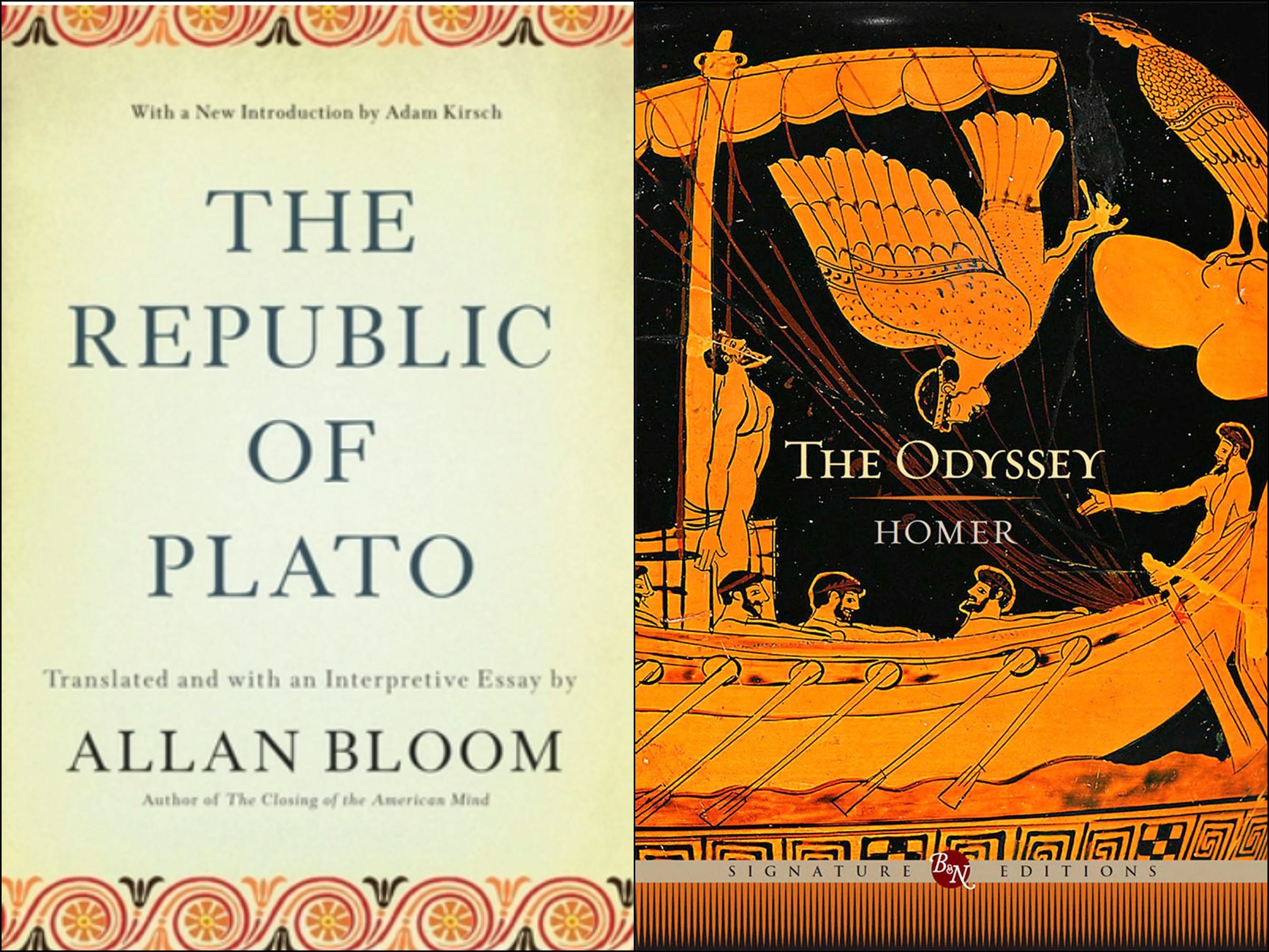
A short five minute presentation I made for The Halkyon Guild‘s Odyssey course. Halkyon is an online philosophy school that I wrote about recent, describing my trips to Athens and Naples with the group:

What could be so harmful about the following verse that we encountered last week in Homer’s Odyssey?1
I would rather be on the soil, a serf to another,
To a man without lot whose means of life are not great,
Than rule over all the dead who have perished.
In Plato’s Republic, Socrates famously undertook a campaign of poetic censorship. Some verses, though sweet to hear, conflict with the aims of the perfectly just city—the city in speech built over the course of the dialogue. To properly educate the children of the city, particularly its future guardians, such verses must be expunged. Their souls must be shaped by tales approved by Socrates and his interlocutors, the founders of the city.2
At the beginning of Book III, Socrates selected the verse above as the first of seven (all of Homer) to ban. Why? The guardians must be courageous and not fear death. “Do you suppose anyone who believes Hades’ domain exists and is full of terror will be fearless in the face of death and not choose death in battles above defeat and slavery?” he asked.3
What does Homer’s verse mean? Was Socrates justified in expunging it? Taken at face value, the verse means that it is better to serve the lowest possible position in life, a poor serf, than the highest in death, the ruler of the dead. It means that life, in any condition, is of infinite value. This would certainly be bad for the city’s guardians, who will be called upon to sacrifice their lives for the city.
But in what context does the verse appear in the Odyssey? It seems unlikely that the hero Odysseus would believe this. Looking at the text, we see that the verse was spoken not by but to Odysseus. It was spoken in Hades, by the soul of Achilleus. He rejected Odysseus’ consolation of his death, which was quite generous:4
Achilleus,
no man before has been more blessed than you, nor ever
will be. Before, when you were alive, we Argives honored you
as we did the gods, and now in this place you have great authority
over the dead. Do not grieve, even in death, Achilleus.
Given this context, banishing the verse does seem justified. If it had been spoken by a weak man and rebuked, perhaps it could be used to teach the city’s future guardians how not to act. But here we see something quite different. One of the Greeks’ most renowned heroes, Achilleus, wishes to cling on to life, even though he had won the highest honors for his courage. The city’s guardians should envy such an honorable death.
This verse was not the first nor the last that Socrates banned, and Homer was not the only poet whose verses got the ax.
Socrates laid down more rules over the following pages. Which verses should be banned? All verses depicting “laments and wailings of famous men,” such as lamenting the loss of a comrade, for it implies that being dead is a terrible thing;5 all verses depicting men (or gods) “overpowered by laughter,” as mighty laughter causes a mighty change in one’s condition;6 all verses discussing men giving in to the “pleasures of drink, sex, and eating,” as it discourages moderation, the key virtue regulating the multitude’s obedience to rulers;7 and all verses portraying men as “receivers of gifts or lovers of money.”8
Socrates’ censorship campaign actually began in Book II. There his motivation was not to instill courage in the guardians but to inspire men to “honor gods and ancestors and not take lightly their friendship with each other.”9 He accused Homer and Hesiod of telling false tales about the gods.10 He laid down two rules.
First, since the gods are wholly good, they only cause good things. All verses depicting the gods causing bad things must be expunged, starting with this one from Homer’s Illiad:11
Two jars stand on Zeus’s threshold
Full of dooms—the one of good,
the other of wretched.
Second, since a god is “in every way in the best condition” and certainly not “wanting in beauty or virtue” he would never transform—for that would necessarily make him “worse and uglier.”12 The following verse from Homer’s Odyssey is the first that must go:
The gods, like wandering strangers,
Take on every sort of shape and visit
the cities.
So, Socrates laid down many rules for poetry in the just city. Many of Homer’s verses would have to go. I had seen these verses many times during my rereadings of Plato’s Republic. It was exciting to come across them during my first reading of the Odyssey for this course and to discover the context in which they appeared. It was especially surprising to learn that the first verse above—expunged for instilling cowardice in the guardian class—was actually spoken by the hero Achilleus.
Odyssey, Book XI, 489-491
Republic, 377c
Republic, 386b
Odyssey, Book XI, 482-486
Republic, 387c
Republic, 388e
Republic, 389e
Republic, 390d
Republic, 386a
Republic, 377d
Republic, 379c-d
Republic, 381b-c