
Being or Becoming?
Philosophy symposium dinners and the new American man


The Meriwether Academy hosted three engaging symposium dinners featuring Mark Anderson, Chair of Belmont’s Philosophy Department, this year. Each focused on a different aspect of Western philosophy, how it can help us understand our contemporary cultural crisis, and how it can help us improve our personal lives (including its limits of doing so).
These dinners have become quite popular in Nashville. Meriwether has now hosted a dozen of them, connecting the group with nearly as many excellent speakers.1 Each now usually attracts thirty to forty men, up from the dozen or so that they had attracted last year when the group was just getting started. These dinners are just one of the group’s diverse set of event offerings for men, which also include outdoor retreats and coffee shop dialogues on books about great men from Ancient and American history.
I’ve been to nearly all of Meriwether’s symposium dinners and other events. I’m consistently impressed by the quality of the events; by the quality of men and speakers that they attract; and by the energy that has grown around the group’s larger mission, which is to build a boys’ school centered around classical and outdoor education, aiming to properly raise up the next generation of American men. Warren Steury, founder of the organization, always does an excellent job hosting these events and has inspired so many men with his vision.

The dinners always have beautiful aesthetics. Guests arrive well dressed, often in a jacket and tie, and congregate in a large room, decorated tastefully with American flags, large pictures of the Founding Fathers, and busts of old Roman statesmen. At the center of the room, a horse-shoe shaped table is fashioned from a dozen or so smaller rectangular ones. The table is beautifully set: tall burning candles, corked bottles of red wine, and platters of bread and butter are interspersed among thirty perfectly spaced white plates, each set with bronze-plated silverware alongside a pen, a notebook stamped with the Meriwether logo, and a plastic-wrapped cigar. Guests mingle for an hour before dinner and smoke cigars after it.
The dinners follow an intriguing format ascribed to Thomas Jefferson. There is one rule: only one person talks at a time, and while he is talking he is given everybody’s undivided attention (no side conversations allowed). The featured guest sits at the head of the table and asks leading questions to the group. Jefferson found, as have we, that this format draws out each person’s unique insights and experiences, leading the group to rich and insightful conversations about politics, culture, philosophy, and life.
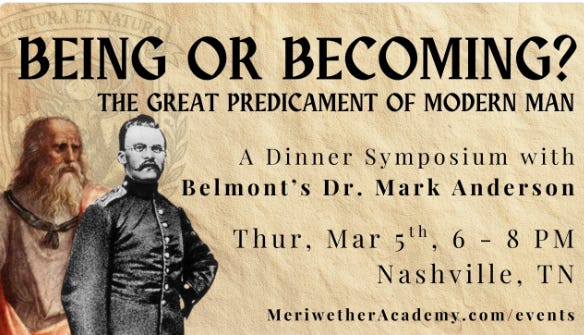
Mark Anderson has led three dinner discussions this year. The first, in January, titled “Reason and the Will”, discussed the Western philosophical tradition, from Plato to Nietzsche. The second, in March, titled “Being or Becoming?” analyzed the history of Western philosophy through the lens of these two philosophical concepts. The third, last night, titled “The Tranquility of Order” focused on the Greek concept ataraxia, interpreted to mean spiritual calm, and actually argued that traditional common sense wisdom is more valuable than deep philosophy in helping achieve personal happiness.
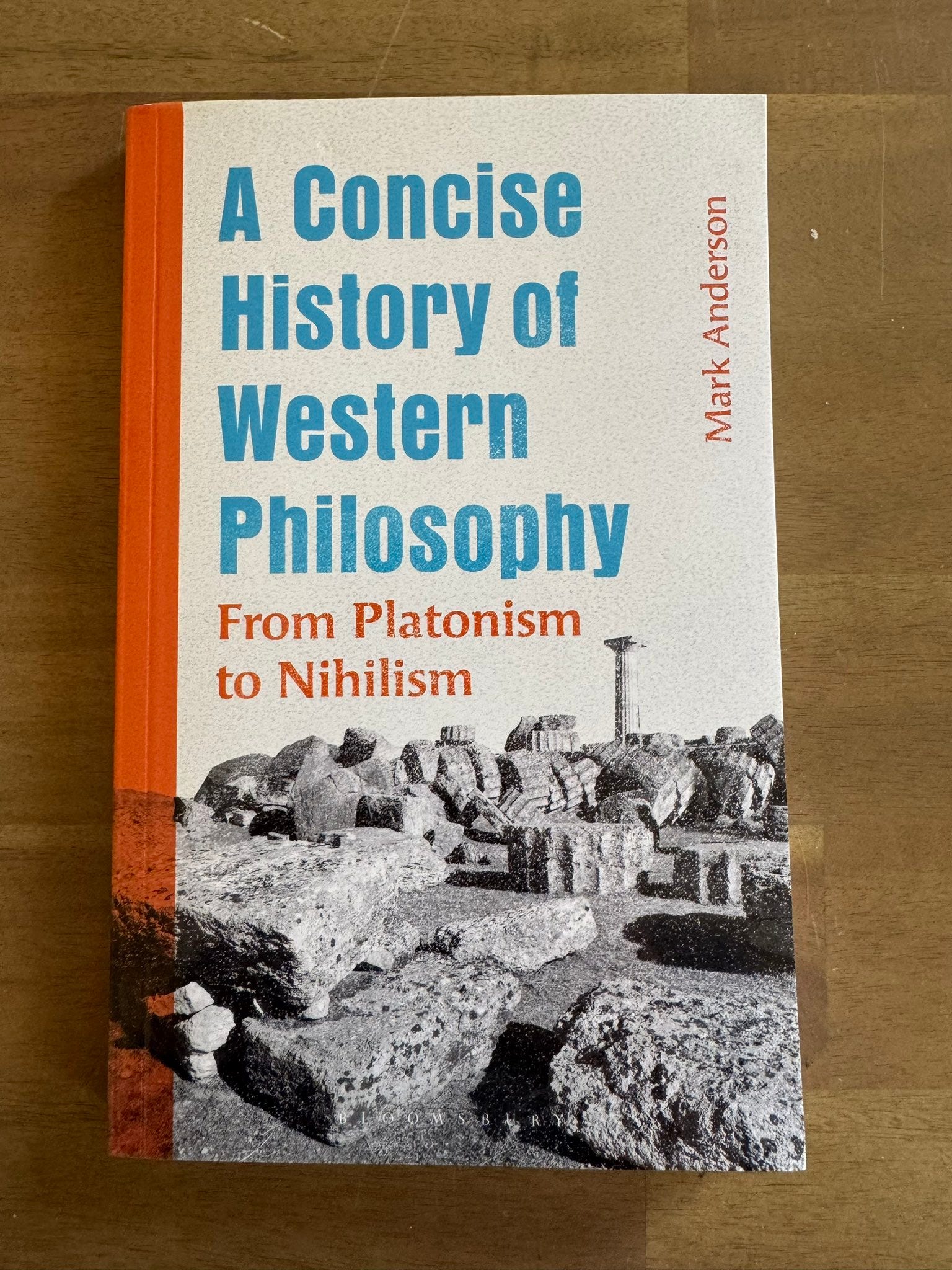
This article is about Anderson’s second event, fully titled “Being or Becoming? The Great Predicament of Modern Man.” Anderson’s presentation was based on his book A Concise History of Western Philosophy, which was one of the best short (150 page) introductions to Western philosophy that I have ever read. (I am currently planning to write articles on several of Meriwether’s other events that I’ve been to, including Anderson’s other two dinners, which will be published on this Substack in the coming months.)
So what did we discuss with Mark Anderson during dinner in March?
Our Cultural Crisis
Our group is concerned with many things in modern culture. Some concerns that men voiced during dinner include: militant progressivism, anti-Americanism, tearing our Founding Fathers down, tearing statues down, rioting, censorship, technology rotting our brains, technology dominating our lives so much we can’t escape it, sexual degeneracy, attacks on masculinity, confusion among the genders, transgenderism, and the normalization of bodily mutilation.
Many men in Meriwether are starting young families. They are worried and ask themselves: Where can my children grow up safely? Where can they lead normal lives? Is there a future for them? One man with a three year old daughter went so far as to say that he feels like we are living in the Kali Yuga, the end times or dark ages in Buddhist mythology. But he has hope that if we all band together we can positively direct our future, which is why he came to Meriwether that night.
It is tempting to blame bad politics, declining educational standards, and technology for many of these cultural problems. These are indeed important causes but they are only surface level, Anderson told us.
Underlying all of this is the problem of nihilism. Nihilism pervades our age. Everything seems meaningless. Some people see no reason to go on living. Others, in the name of radical freedom, claim they can do anything with their lives and bodies. Nothing is true or right, there is just your opinion and mine. Our culture is just our preference, foreign ones theirs. Neither is inherently better. All things change. Nothing is worth preserving.
How did we Get Here?
Nihilism didn’t come from nowhere. It was deeply influenced by the modern philosophy of Nietzsche (whom Anderson wrote his PhD thesis on). What underlies Nietzsche’s philosophy? What trajectory of philosophical thought led to his?
Anderson wrote a book, A Concise History of Western Philosophy, which helps explain this. This excellent short book really helped me get a holistic grasp of Western thought as I’ve been learning philosophy myself over the past few years. (I’ve also been studying with a number of independent online schools, including one that took us on trips to Athens and Italy).
Western philosophy, for Anderson, can be understood as a tension between two concepts: Being (represented by Plato) and Becoming (by Nietzsche). Each concept is shorthand for a set of interwoven concepts. In his book, he put it this way:
“’Being’ suggests immateriality, eternity, order, the really real, and the objective knowledge of truth, goodness, and beauty. ‘Becoming’ evokes corporeality, ephemerality, change, the perspectival, and the subjectivity or relativism of all cognition.”
Anderson took us through thousands of years of philosophy that led us here—an impressive fifteen minute speech! In ancient times, with Plato and Aristotle (in the 300’s BC), Being dominated philosophical thought. Augustine (in the 400’s) was a Platonist who solved the problem of essences (what gives reality intelligibility). Medieval philosophers, like Aquinas (in the 1200’s), refined ancient insights, synergizing them with Christianity.
In modern times, however, Becoming gradually took hold. Descartes (in the 1600’s) came along and subjected belief to radical doubt: we don’t really have access to the external world, we only have ideas about it. Kant (in the 1700’s) radicalized this subjectivism: we have no reason to believe that what our minds are doing is true. Nietzsche (in the 1800’s), adopting this worldview, said we are free to construct reality in our heads.
So, the ancient world was objectivist and common sense, the dominion of Being. The modern world is subjectivist, the dominion of Becoming. This is what led to modern nihilism, influenced primarily by Nietzsche’s philosophy.
Dinner Discussion
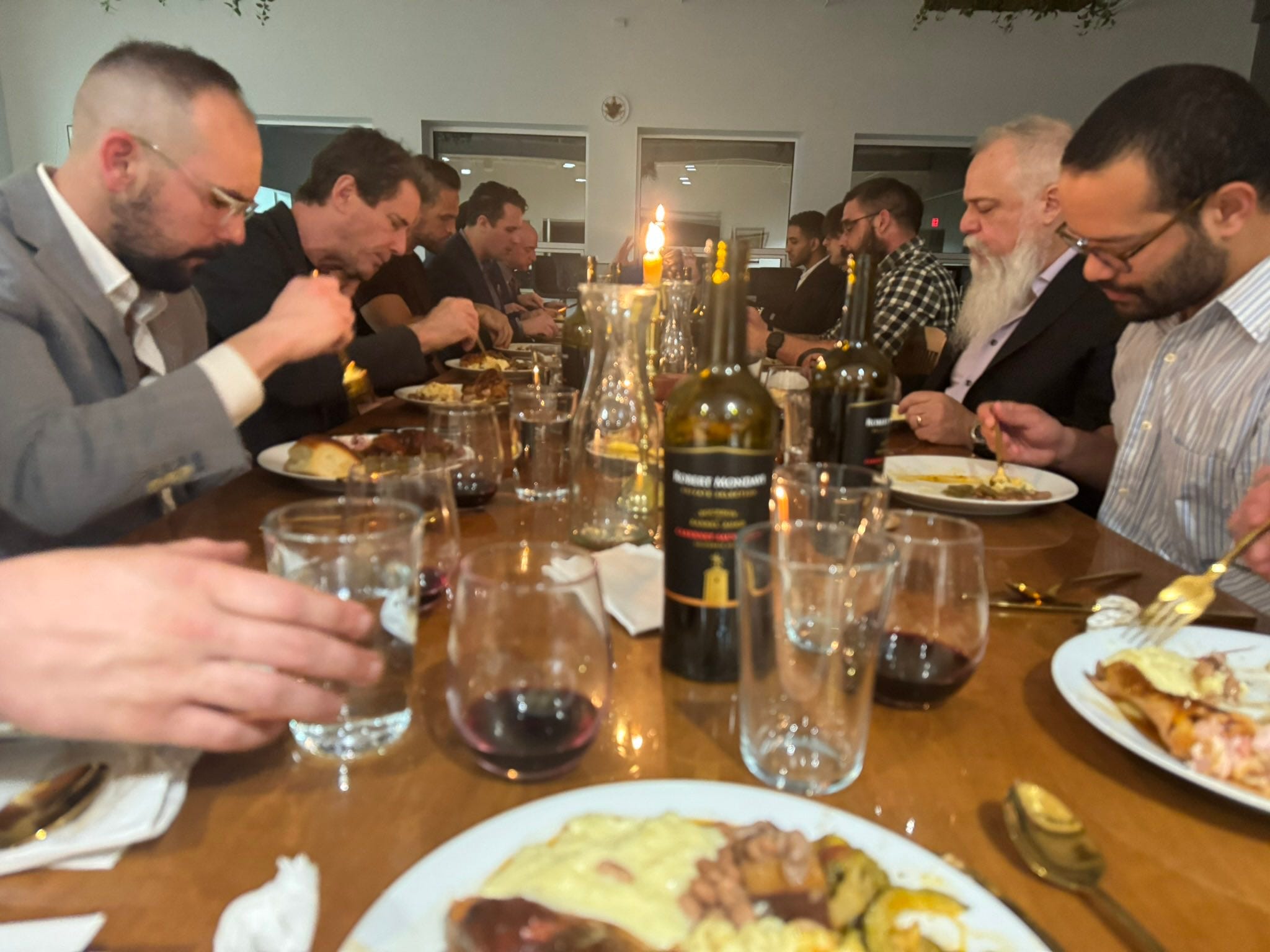
After Anderson’s short lecture, we lined up to fill our dinner plates buffet style with chicken, mashed potatoes, steamed vegetables, mac and cheese, corn bread, and other Southern food from a classic Nashville restaurant. We sat back down and started to eat, as Warren told us the rules for the Jeffersonian-style dinner discussion, which Anderson was to lead.
Anderson asked anyone with simple questions to go first. Too often people with complex or esoteric questions raise their hands first and it bogs the conversation down. (This is a great practice that we should adopt more widely.)
What does “God is dead” mean? Most of the men in Meriwether are Christian and many took issue with Nietzsche’s proclamation.2 “God is dead,” Anderson told us, is not merely an atheistic proclamation. It means something much deeper. By God Nietzsche really means Being. He means that there is no intelligibility built into reality that man can truly know.
How does Thomas Jefferson fit into the history of Western philosophy? One attendee, a self-identified American exceptionalist, wondered why no American philosophers were discussed. Anderson said that Jefferson was a great thinker and statesman but, although he studied philosophy, he did not greatly influence it. Nor did any of the other American Founding Fathers.
How has Nietzsche influenced American culture? Anderson said that his influence is implicit in the dominance of Becoming today. Nietzsche was also a big influence on H.L. Menken who had written an early book on him and had mentioned him in many articles. Menken himself was a highly influential American journalist in early 1900s who coined terms like “Bible Belt” and “Monkey Trial.” Finally, Nietzsche is also promoted heavily in pop culture today.
Is transgenderism caused by radical subjectivism? Anderson said that it is a rejection of nature (Being). It is a result of the post-modern culture, the ethos: “Who’s to say what’s right and wrong?” Is Christianity a solution to this crisis? It could be. But in practice, many Christians (even those at Christian universities like Belmont) adopt subjectivist views because they grew up in a post-modern culture.
Philosophy and Life
How should we approach our reading of the great books? How can they actually help us in our lives?
Anderson shared some personal stories and struggles. He said that he was sitting in his office one day with a bookshelf full of philosophy texts that he had spent a lifetime mastering. They discussed the deepest questions about human life and even about existence itself. But they didn’t help him. Instead, he found greater help in simpler books about dealing with grief and struggle written for the general public.
This is something I have often seen from scholarly people attracted to our movement—and I think it points to what our movement might uniquely be able to offer. Academic institutions have failed to show how the great books can really shape our lives. Groups like Meriwether are sincerely asking these questions. They recognize the importance of molding a man holistically, and that the failure to do so is perhaps the central error of contemporary education.
Following this point, Warren formally concluded the dinner discussion. The table would soon disperse to begin informally socializing. But before we rose something incredible happened. Warren announced that he would donate some of the dinner’s proceeds to good cause. Did anyone know someone in need?
One attendee volunteered. His friend, a veteran and father, had called him recently, depressed and lost, even contemplating suicide. He saw no purpose in life, felt no one cared, and struggled financially. The group unanimously agreed to the nomination and Warren sent him a check. The nominating attendee thanked the table, saying that it would help his friend financially and, more importantly, show him that other men actually cared.
Imagine this replicated across the country, in hundreds of American cities every week: groups of men gathering to gain wisdom, improve themselves, and our country; experts leading deep discussion on Western philosophy and culture; and the group reaching out to lift up struggling friends and members of the local community.
What effect would that have on America? What will ultimately come of our movement? Will it be a new educational paradigm, educational curriculum, cultural rituals and practices, or way of life? A new connection between citizens and among aspects of the human soul that have been unduly separated by current institutions?
How to Grow our Movement
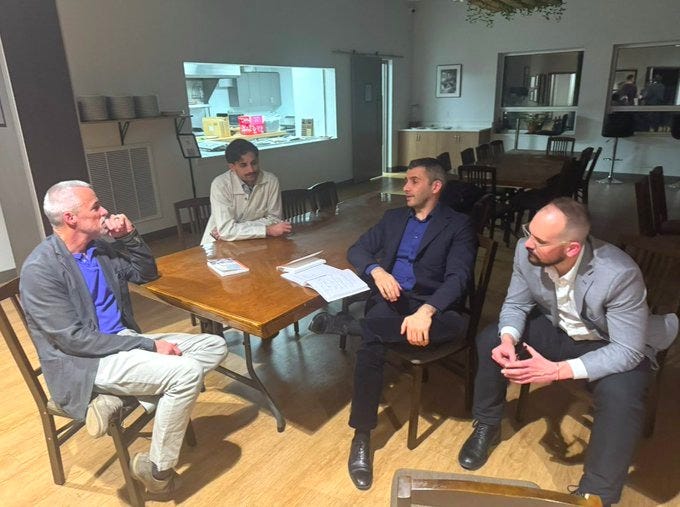
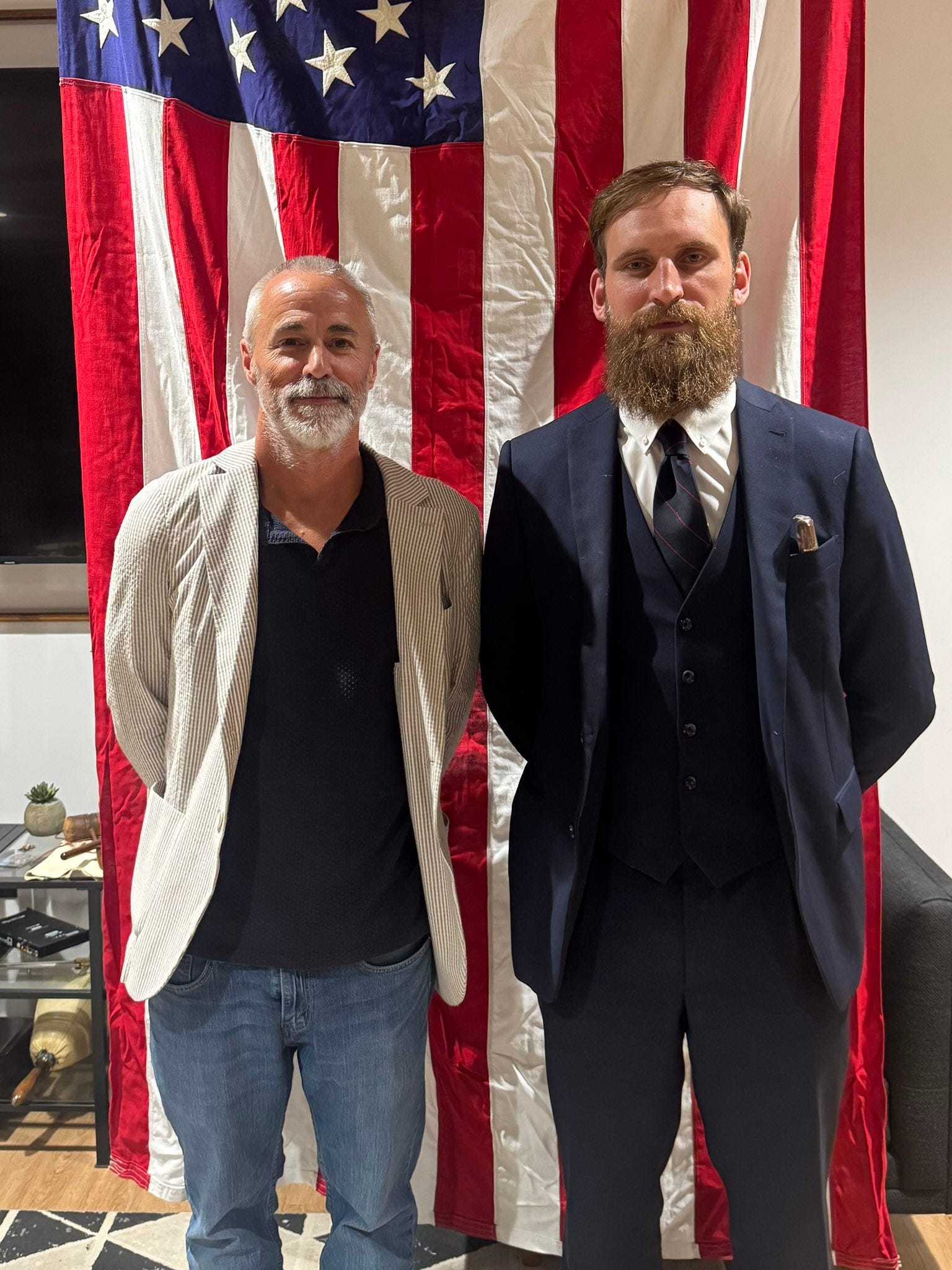
It was great to connect with Mark Anderson, to finally find a professor in Nashville who shares the group’s vision. It was inspiring: there might be other professors within institutions who are looking to help cultural organizations like Meriwether grow and thrive.
How can we connect with them? What would motivate them? Anderson told me three things. First, and most importantly, the attendees want to be here and are excited to learn; most students at university are not. Second, attendees here are older and have more life experience. This gives them more depth in discussing philosophical concepts and the wisdom to assess their practical value. Finally, these events are fun and exciting. They are something that many professors would enjoy going to and speaking at.
Our movement has identified a unique demographic. A new kind of student, lifelong learners with a civic duty and mission, is emerging. They are learning on their own and at groups like Meriwether. And they have ambitions to educate their children in a similar way. How can we leverage this insight?
One thing that came to my mind: I think our movement will create a growing demand for books like Anderson’s. Short, digestible books on philosophy (or Western culture) that do not dumb it down. He told me that he wished that some of his colleagues, who are experts on philosophers like Aquinas, for example, would write books in a similar fashion. They have a lot of knowledge to share but write books that are too long and narrowly directed towards scholars. I think this would be very valuable for our movement, something that we should pursue in the coming years.
This was another excellent Meriwether event! I’m consistently impressed by the quality of men and speakers that the group’s events attract. There is a real hunger for this kind of knowledge and community. I’ve become friends with many of the men that I’ve met here. I’m very grateful to have this group so close to where I live in Nashville.
Thanks to Warren for putting this all together and to Mark Anderson for speaking. I’m looking forward to further collaborations between them and am excited to see what this group, and the wider grassroots cultural-educational movement that I have been writing about, will evolve into.
Anderson actually discovered Meriwether online after coming across a post about the group’s first set of symposium dinners last summer featuring Michael Millerman. Millerman taught us about political philosophy, focusing on the work of Leo Strauss and on Allan Bloom‘s Closing of the American Mind. The post inspired Anderson, a Nashville-based professor, to connect with the group on X.
This now-famous declaration came to us through the mouth of a madman in one of Nietzsche’s most beautiful and gripping parables, which first appeared in his 1882 book The Gay Science (sometimes translated as “The Joyful Wisdom”).
“Have you not heard of that madman who lit a lantern in the bright morning hours, ran to the market place, and cried incessantly: ‘I seek God! I seek God!’” the parable famously began. The madman, to his incredulous listeners, would go on to characterize the death of God as a crisis, one that perhaps irreversibly drained life of all meaning and orientation:
“What were we doing when we unchained this earth from its sun? Whither is it moving now? Whither are we moving? Away from all suns? Are we not plunging continually? Backward, sideward, forward, in all directions? Is there still any up or down? Are we not straying, as through an infinite nothing? Do we not feel the breath of empty space? Has it not become colder? Is not night continually closing in on us?”