
An Ancient World and a New Polis
Athens, Naples, and the fate of Western civilization

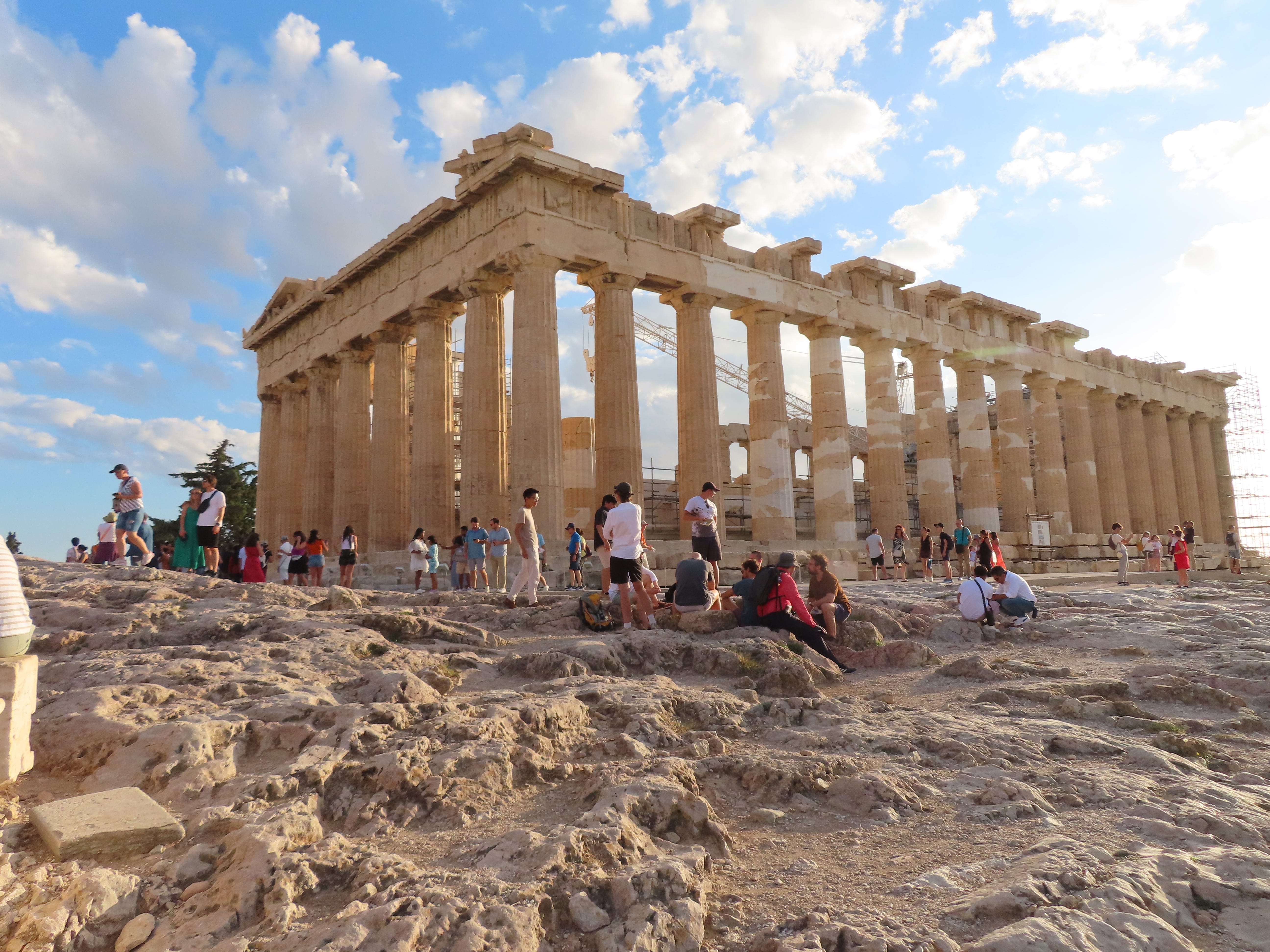
The Halkyon Guild is an online philosophy school led by Johannes Niederhauser, a European philosopher who left academia after completing his PhD to found the Guild. The school teaches courses on foundational philosophical texts and on important contemporary topics, such as the essence of modern technology, viewed through a philosophical lens. I’ve studied with Halkyon online for several years. In September 2024, I attended its first in-person event, in Athens. Last October, I attended its second, in Naples, and then visited Rome on my own for a few days. This article reports on these trips and then reflects on Halkyon in the context of my animating socio-political concerns.
These concerns, as I’ve written about previously, center around the disintegration of our culture and educational institutions, which I witnessed first hand during graduate school for computer science in the 2010’s. They include: increasingly regular political violence and censorship; the complicity of our universities in instigating this chaos; their failure to cultivate a community of thinkers capable of mitigating it; and the degradation of the meaning of human life, particularly our seemingly inescapable domination by high technology, potentially culminating in transhumanism. These concerns animated me to exit mainstream academic and professional institutions, to begin studying the great books of the Western canon, and to join the emerging, loosely connected movement of independent scholars, creatives, and activists similarly (though distinctly) critical of academia and modernity.
It was this journey that led me to Europe for the only two times in my life. I accepted Niederhauser’s invitations to Athens and Naples with enthusiastic curiosity. What might the ancient Greek thinkers—the pre-Socratics, Socrates, Plato, and Aristotle—and the medieval to modern Italians—Dante, Machiavelli, Vico, Bruno, and Croce—be able to teach me about modernity? The places too might have something to teach me. How might Athens, cradle of Western civilization, site of the dramatic life and death of the great Socrates, reorient my lifelong journey? What might I learn from seeing the world-historic sites in Naples and from visiting Italy, homeland of my ancestors? What might contemporary Europe have to teach me about America? How might these trips complement my explorations of the American heartland?
This article about Halkyon is one of a collection I’ve written, each reporting on and then reflecting upon my experience engaging with a single group in the movement. Each article has two aims. First, to advocate a group I’ve found valuable to potential students. Second, to help understand and advance the movement. The movement is nascent and largely unknown. It is decentralized and entrepreneurial. Its groups are politically, religiously, and ideologically diverse. Each group has unique insights into certain core problems of modernity and possible solutions. Each is confronting similar challenges associated with geographic isolation and lacking institutional support. Each is addressing them with innovative pedagogical practices, business models, modes of intellectual inquiry, and ways of building community, both on- and offline. Collectively, the articles aim to showcase best practices that can be adopted throughout the movement and to unearth principles that can be used to guide its intellectual and communal development as it advances beyond its experimental beginnings.
This article thus proceeds as follows. The first section discusses the Athens event, reporting on our group’s philosophical dialogues and then on our explorations of the city and its ancient sites. The second section reports on my trip to Italy in a similar manner. The third reflects on the trips in the context of the wider movement. Elaborating on the sketch above, it first discusses Halkyon’s educational vision, shedding light on how the movement’s independent schools are evolving, and then examines the community that is evolving within the movement, asking how we should guide its development going forward.
This article’s title (including its subtitle) has two meanings. It refers to the trips’ locations: Athens, the ancient world, and Naples, originally named Neapolis, meaning new polis, or new city. It also means that only a “new polis“ can save the West, interpreted in two related ways. First, that our emerging movement is a new polis, a new “city” formed from cultural-intellectual refugees from mainstream institutions and big city power centers. Second, that its central task is to lay the intellectual foundations for a new socio-political order in the West, a new “polis“ free from the worst ills of modernity. It is for this task that we must turn to the great thinkers of our ancient and early modern past.
Halkyon in Athens
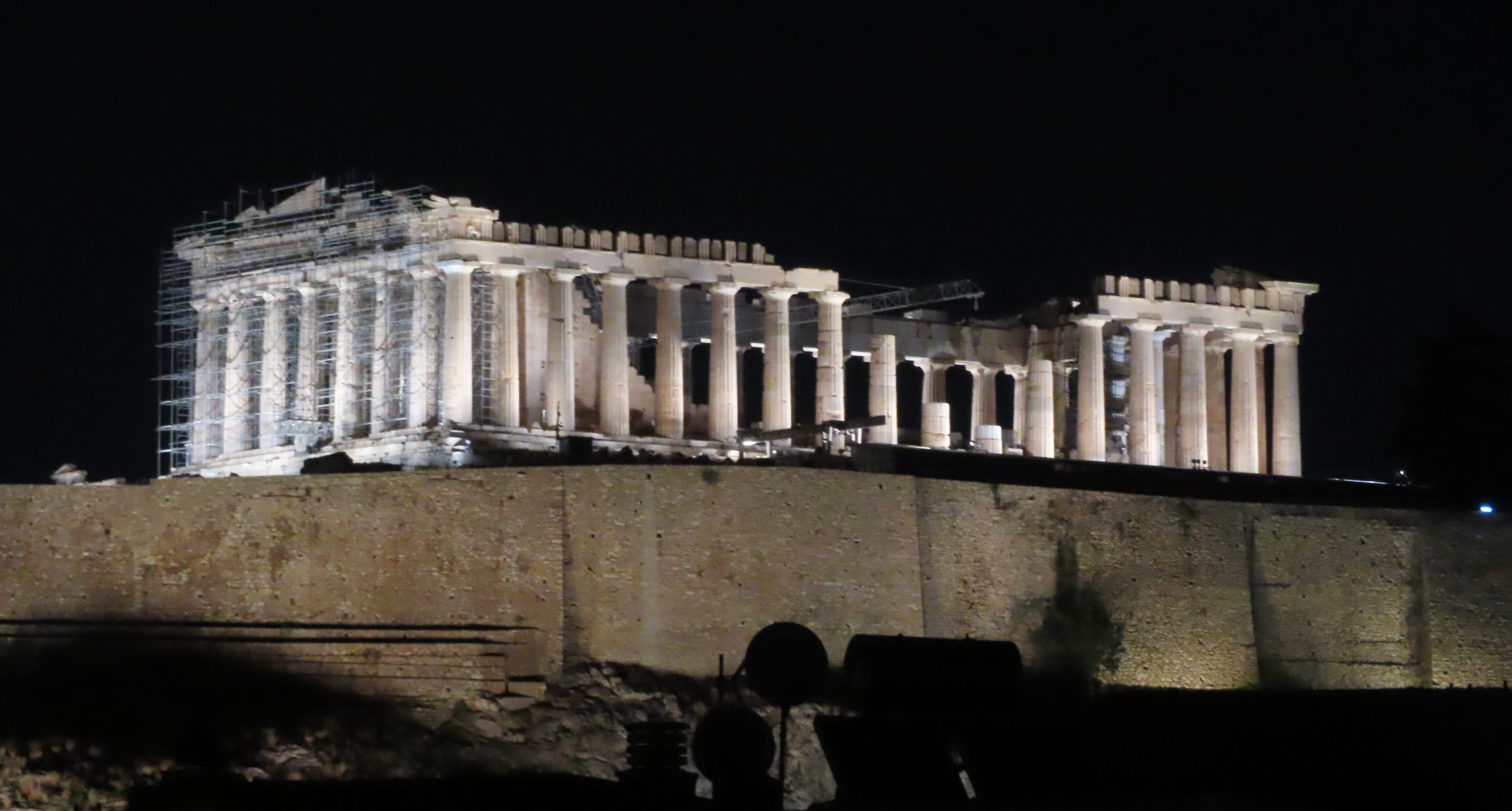
In September 2024, I joined Niederhauser and about a dozen other students for Halkyon in Athens, the Guild’s first in-person event. Prior to the event, Niederhauser had assigned readings from ancient Greek texts including: Plato’s Symposium, Phaedrus, and Republic; Aristotle’s Metaphysics and Nicomachean Ethics; Homer’s Iliad; Heraclitus’ Fragments; and Parmenides’ “On Nature.” Each night, we met at Niederhauser’s rented flat, which had a clear view of the beautifully lit Parthenon, for light snacks and—inspired by the ancient Greeks—an ample supply of wine, which facilitated a long dialogue on one of the assigned texts. On most afternoons, Niederhauser led us on tours of ancient sites, stopping at some of them to lead a short discussion on a relevant text. We spent most of the informal portion of the trip together exploring modern Athens, often talking late into the night at the city’s popular restaurants and bars. The first subsection below reports on our philosophical dialogues, the second on my travels through Athens with the Halkyon group.
Dialogues with the Ancients
Niederhauser opened the event on the first night with a toast. He thanked us all for coming to Athens. He said that it was his dream to have a school of his own which our participation in this event—as Halkyon’s first in-person event—was helping bring to life. The students here (in Athens and in Halkyon more broadly) are here because they are in love with philosophy and learning. They have no need for external rewards like degrees, prestige, or career advancement. These perverse incentives have led to the deterioration of authentic philosophical inquiry in modern academia, which largely fails to recognize the texts of the great thinkers of the past as living works that speak to us today—works that speak to our deepest concerns, that help us understand who we are as human beings and how we should live our lives. Niederhauser left academia to found Halkyon in part to help revive this kind of inquiry.
He began each night’s dialogue with a short speech on one of the assigned texts, intended not as a lecture but rather as a seed for further discussion that students would actively participate in and shape. He discovered through teaching in this way online that students often take discussions in directions that he never would have anticipated. This is one reason why he loves teaching and believes that dialogue (with the right students) is such a powerful educational method. Moreover, dialogue lies at the heart of philosophy: reason is dialectical; dialectic creates tension that raises the discussion to a higher level; philosophy is not only discursive but inherently argumentative; the Greeks embraced and were playful with disagreements and contradictions that arose. But contrary attitudes dominate today: people want every question to be resolved immediately to an answer—one that can be easily “looked up” on Wikipedia—and universities want every lecture to deliver a predefined “learning outcome” to each student.
Each night, we sought to rekindle a dialogue with the ancients, a severed connection that our presence in Athens persistently reminded us of. How did the ancients see the world differently from us? How can they help us understand the essence of modernity and the scientific mindset that dominates our age? How can they help us see the phenomena of the natural world more clearly and not become entrapped in abstractions, such as those created by the digital world? How can we genuinely read and truly understand their ancient texts?
For this task, the modern philosopher Martin Heidegger was seen as an essential guide. His phenomenological approach unearthed profound insights into the essence of language, thinking, being, truth, metaphysics, and other ideas central to Greek philosophy. Phenomenology teaches us to be in “dialogue” with phenomena. We should not presume, for example, that we can immediately grasp what something even as familiar as a “jug“ truly is. Instead, we should pause, question it, and let its essence shine forth, aiming to grasp it at a deeper level. Similarly, we should not presume that we can immediately grasp a text of Plato’s, and we should be especially aware of how its modern interpretations may conceal its essence from us.
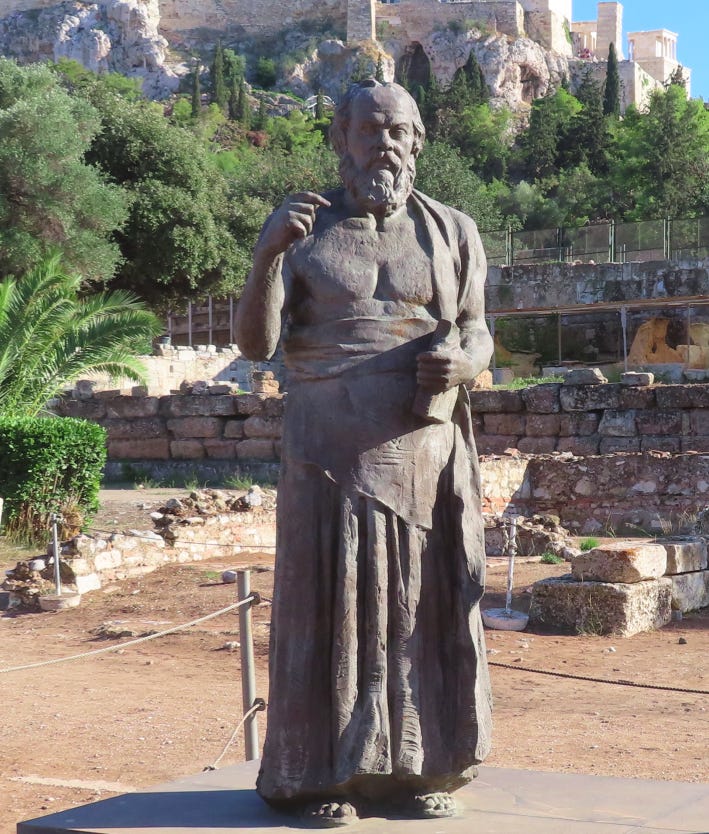
On the first night, we discussed Socrates’ purported dialogue with Diotima in Plato’s Symposium. Their dialogue illuminates two crucial aspects of philosophy that have been forgotten today. First, that philosophy, the love of wisdom, is erotic and intimately related to the divine. Second, that philosophical inquiry into phenomena necessarily dwells in the “in between.” Diotima teaches Socrates about Eros. She rejects his initial view that Eros is a god who is beautiful and good. Socrates presumes that Eros must then be ugly and bad. She chastises him for “compelling” the beautiful to its opposing pole, of presuming that nothing exists between beautiful and ugly. She further explains that Eros is not a god but a daemon, occupying the space between gods and mortals, playing the crucial role of facilitating conversation among them and binding together the whole. Moreover, Eros philosophizes: “For wisdom is one of the most beautiful things, and Eros is love in regard to the beautiful; and so Eros is—necessarily—a philosopher; and as a philosopher he is between being wise and being without understanding.”1
We discussed the importance of embracing the “in between” today. Philosophy collapses when we lapse into one answer or another, as occurs in political dialectic between opposing sides today. More subtly, modern technology conceals the “in between”: it pulls us into the degenerate realm of the known (as with “looking up” answers online), and hence stifles creativity. It is easy to be on either side of a debate but hard to be in the “in between”; it is easy to demand an answer but hard to truly embrace the question in all of its mystery and apparent contradictions. We as thinkers today must relearn the art of this embrace from the ancient Greeks.
On the second night, we discussed the famous cave allegory from Plato’s Republic, focusing on the concepts of ascent and descent. The allegory envisions prisoners chained in a cave, trapped since birth in a false reality created by shadows cast on its wall. One day, one of the prisoners is unchained, dragged up out of the cave, and shown the world of real objects illuminated by the sun, which he gradually begins to see clearly. When he descends back into the cave, he is not celebrated but rather mocked and threatened by the other prisoners, for now being unable to see the shadows clearly. The allegory symbolizes the perennial tension between the philosopher and the political community. It symbolizes the philosopher’s spiritual-philosophical ascent from the opinions of his city (the shadows in the cave in which he was born) to knowledge of the good (the sun), and his subsequent descent back to the city to attempt to educate it and order it to attain the good.
Our discussion focused on how modernity, particularly the Enlightenment, distorted two of the allegory’s key questions and teachings. First: What is the philosopher’s responsibility to society? The Enlightenment sought to eradicate prejudice by instituting universal education, erroneously believing that the cave’s shadows could be eradicated—that it is possible to create a world in which the sun is always shining. It also forgot that there is pain in returning to the cave: the philosopher is happier outside and must be forced to go back down, to dwell among the prisoners, and to set the city in order. Second: What is the good? The Enlightenment introduced the notion of “values” and the authority of scientific measure and quantification. While the telos of ancient politics was to order the polis to attain the good, the telos of modern politics is to order the state to optimize some utilitarian metric—such as GDP or, ideally, some all-encompassing “happiness index”—a degenerate form of the good.
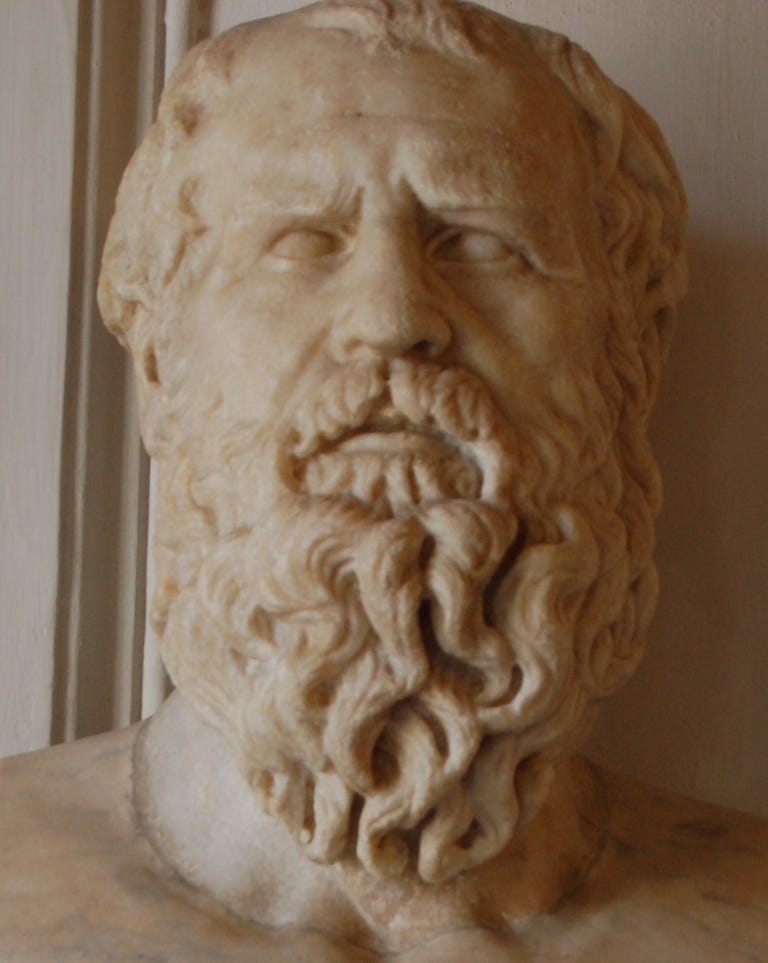
On the third night, we discussed Heraclitus’ Fragments, incorporating elements from Homer’s Iliad into the discussion. The dialogue focused on the intimate relationship between language, being, and divinity. Heraclitus is most famous for two fragments. First: “You cannot step into the same river twice.” While often taken as a mere articulation of material fact (that the river’s flow consistently brings new water), the fragment highlights a much deeper danger inherent in language. The very act of speaking inextricably unifies and differentiates things. It makes things that are not the same the same, collapsing them into oneness, collapsing particulars into universals, such as a particular tree into a universal “tree.” Second: “War is father of all and king of all.” War is not just fighting but also a paradox of being and language. It inherently differentiates—dividing people into sides, differentiating individuals into roles, and singling out one as a leader—but, conversely, it involves the many acting as one. Illustrative of this paradox is Hector’s being absorbed into war in the Iliad, his personal wishes being dissolved into those of his group, the Trojans, fighting other groups.
Unlike the ancient Greeks, we largely fail to recognize the intricacies and dangers of language today. The information age presumes—even demands—that everything be named and classified. Individual things are coerced into categories, like human beings into demographic groups, so that they can be reasoned about cleanly. Erroneous conclusions are viewed merely as model errors, demanding refined categories, not as evidence of the fundamental dangers of naming, as Heraclitus understood. Moreover, in our age, language bears an inferior relationship to reality. It is seen merely as a tool used to represent reality, one that operates by composing arbitrary symbols obeying man made rules. But for the Greeks, language was intimately bound to being and even had divine origin, evident, for example, in the Iliad‘s opening line: “Sing to me of the man, Muse[.]” These richer understandings of language were recovered by some moderns, primarily Heidegger and Hölderlin, who poeticized: “the most dangerous of goods, language, has been given to man [by the gods.]”
The fourth and final night focused on Parmenides’ poem On Nature. One of the students, a poet himself, read the work aloud, set against the backdrop of the beautifully lit Parthenon from Niederhauser’s balcony. The performative reading exemplified a point we discussed later: poetry in contrast to prose is meant to be experienced, not merely read, to draw the hearer away from appearances and towards the truth. In the poem, Parmenides narrates his enchanting journey to receive a divine revelation. He is carried “far from the beaten track of men” on a chariot drawn by “wise steeds” and tended by “immortal charioteers.” He encounters a series of divine women. First, daughters of the Sun, maidens who guide his way. Second, Avenging Justice, who, persuaded by the maidens, opens “mighty doors” blocking his path through the “gates of the ways of Night and Day.” Finally, beyond the gates, a goddess who, convinced that “right and justice” had sent him, “greeted [him] kindly” and spoke of two ways of inquiry: the way of Truth—the eternal, unchanging nature of reality—and the way of doxa—human opinion, mere seeming, what mortals incorrectly believe to be true.
Guided by Heidegger’s interpretation, we discussed Parmenides’ many profound insights into being—how it relates with thought, nothingness, and becoming—and into spoken language. Regarding the relationship between being and thought, we focused on one of his goddess’ revelations: “For thou canst not know what is not—that is impossible—nor utter it; for it is the same thing that can be thought and that can be.” Whereas metaphysics attempted to establish a unity of being and thought, Parmenides (a pre-metaphysical thinker) recognized that they are related more deeply: they belong together. They are not two separate things that must be fitted together, as if attempting to unify our “mental model” of the world with reality, but are instead essentially identical and inseparable—much as being and Dasein (man, the thinker) are inseparable for Heidegger. Overall, Parmenides was seen to provide many insights that have been concealed over the course of Western philosophy, thus providing a unique path to understanding how modernity came to be and, speaking with Heidegger, insight into how to inaugurate a new beginning to philosophy.
Exploring Athens with Halkyon
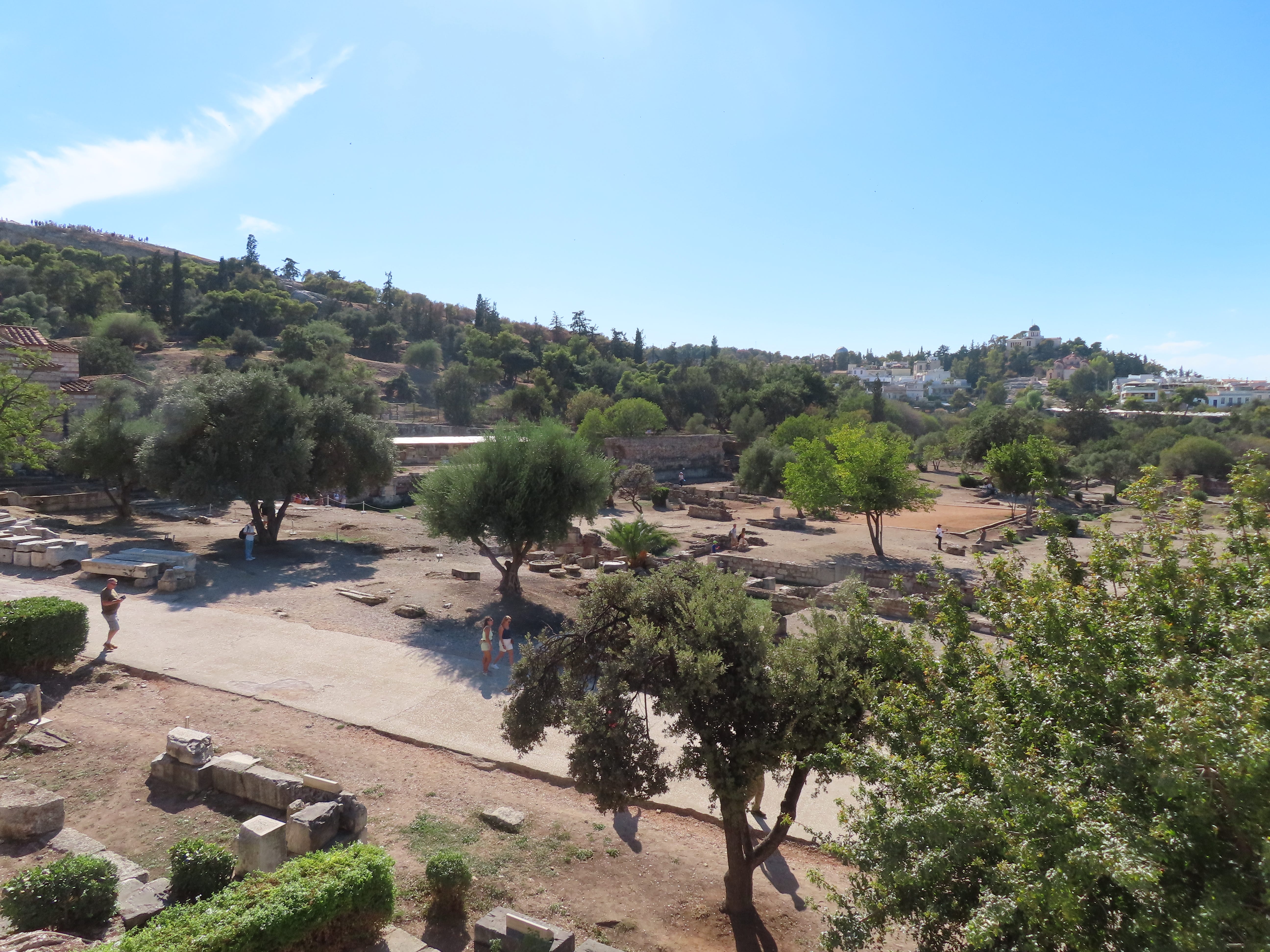
This was my first trip to Europe, as it was for most of the other American attendees. I might have never visited the continent in my life had it not been for Halkyon. I generally look down upon popular tourism and I would not have thought that seeing the ancient sites in Athens would have been valuable to my intellectual mission had a group I respected not organized the trip. Attending the event changed my mind in some important ways. This subsection discusses my experience touring the ancient sites, meeting the Halkyon group in person, and seeing Europe for the first time.
I landed in Athens and found my place in the city center with a few hours to spare before the event. I wandered the surrounding area, forming my first impressions of the city and of Europe. It was a familiar yet foreign world. I didn’t speak the language at all. I had never felt so isolated, being unable to speak to anyone around me, or, when I tried, forcing them to speak to me—an uninvited American tourist in their homeland—in broken English. Everything was smaller there. Their narrow roads were trafficked by tiny cars (not a single SUV in sight), lined with little shops and convenience stores, and overlooked by the narrow balconies of simple box-shaped homes. The city was busy but not overwhelming, with spacious outdoor squares, themselves lined with cafes and restaurants, placed every few blocks. Modern life moved along with little regard for the ancient civilization that once stood right there, a point confirmed by my waiter at lunch who, seeing a copy of Plato’s Sophist that I had bought at a nearby bookstore, directed our conversation towards philosophy and expressed disappointment that most of his fellow Greeks had never even read the authors who had made their little island famous to the world.
That night, I walked to Niederhauser’s apartment for our group’s dialogue on Plato’s Symposium. It was here that I began to discover the people behind the faces that I had seen on screen for years. About half of the students were from America, half from Europe. Most were professionals in their twenties and thirties, many of whom, like me, did remote work, which allowed them to attend this event. Among them were: an American software developer whose deep knowledge of world history enriched nearly every conversation; a German SAT tutor whose sudden interest in Kant had inspired him to join Halkyon; a Mexican software developer who came bearing Mezcal; an American PhD student studying Latin and the classics; a German translator of English legal documents; an American traveler infatuated with Schopenhauer; an English crypto developer with a passionate interest in poetry; and two Los Angeles based entrepreneurs determined to find the most “happening” spots in Athens for our all male group to go to, succeeding, if at nothing else, at sustaining Eros as prominent theme of discussion throughout the event.
After the dialogue, we departed for the nearby bars, where we wound up talking all night. Everyone genuinely liked each other, Niederhauser observed, relieving some concerns that he had had about hosting the event. We decided to spend nearly the entire informal portion of the trip together, developing a camaraderie over those four days much stronger than anything that had developed over years online. We had many outdoor dinners together and spent each night as we had the first, exploring the city’s popular cafes, lounges, and bars. These fun and friendly excursions were interwoven with engaging discussions on life, beauty, business, politics, philosophy, and many other topics, drawing from the group’s diverse interests and experiences. Being immersed in our own world of good conversation for four days, particularly on topics that would not arise online or in formal classes, was one of the most valuable aspects of the trip, a point I will return to shortly.
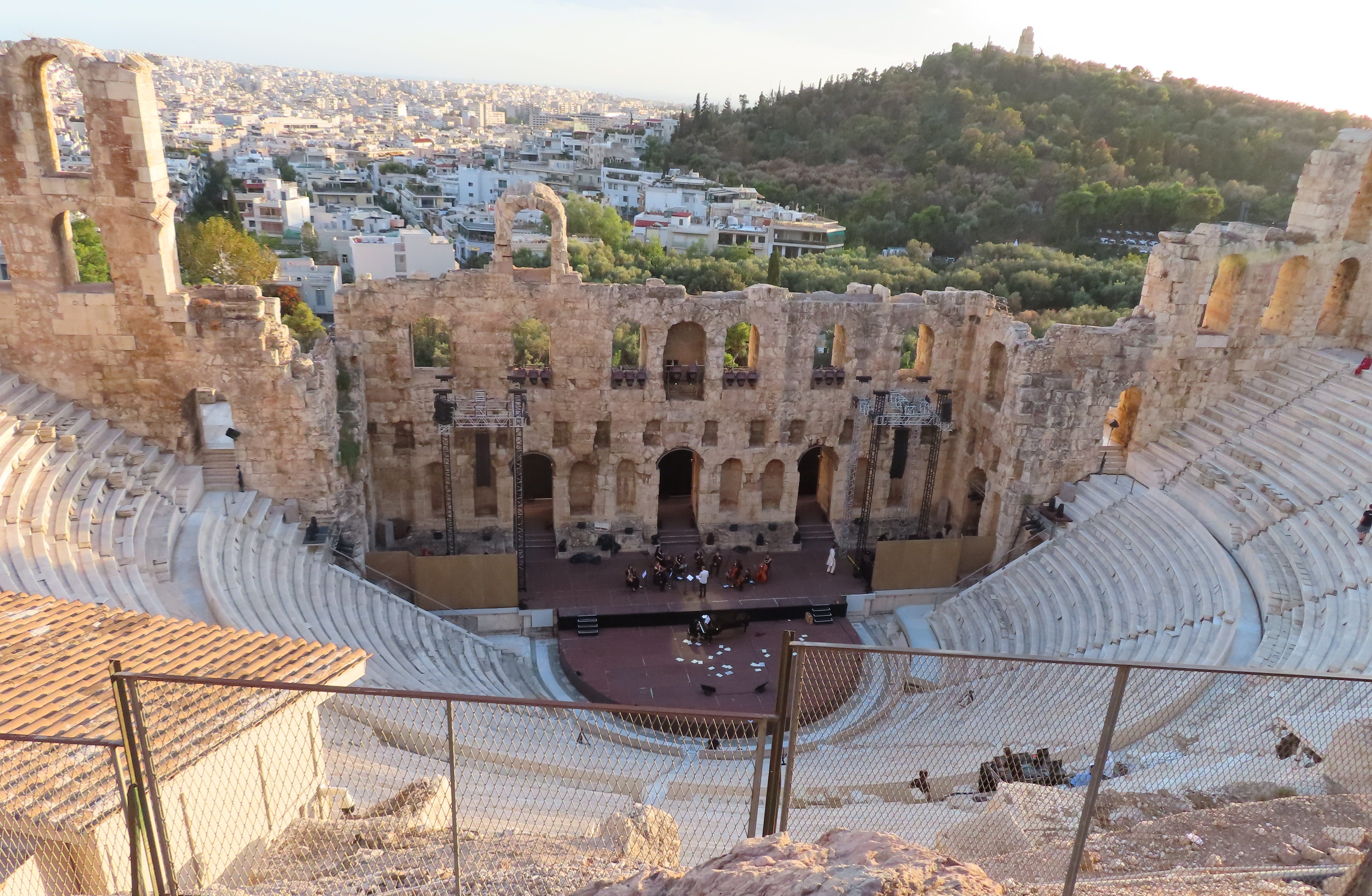
Most afternoons, Niederhauser led us on tours of ancient sites. We toured the Parthenon, bringing to life the building that I had seen countless times in photographs; the Ancient Agora of Athens, the central square of the ancient city, on which many temples, monuments, and other buildings still stand; Aristotle’s Lyceum, stopping at its periphery to discuss the famous passage on friendship from his Nicomachean Ethics; and Socrates’ (alleged) prison cell2, which was the site I had most wanted to see, partly to honor the life of the man who had first inspired me to study philosophy. At other times, we broke up into small groups and saw other sites as we traversed modern Athens. We watched the sun set with locals and tourists atop the Areopagus; we went down to the Piraeus, the Athenian port and Socrates’ destination at the beginning of the Republic, to depart for Aegina, the nearest of Greece’s many scenic islands; and we attended a concert featuring beautiful Greek opera music in the Odeon of Herodes Atticus, an ancient amphitheater at the base of the Acropolis.
It was incredible to see sites over two thousand years old, much older than anything we have in America. Even more, to participate in them during daily life: to attend a concert in the Odeon or to look up at the Parthenon, built atop the Acropolis, meaning “high city,” during our trip through Syntagma Square, the center of modern city life. It made the ancient world feel more real, less like a mere backdrop for stories that I had read in history and philosophy books. But did seeing the sites help me understand philosophy any better? Did standing atop the Areopagus enrich my reading of its account in the Phaedrus? Did seeing Socrates’ prison cell help me understand any of his many beautiful lines in the Phaedo, set there on the day of his death? Did I “go down to the Piraeus” in the same way that Socrates made his descent at the beginning of the Republic? Did Aristotle’s Lyceum help me understand the Nicomachean Ethics‘ teaching on friendship?
It was not philosophy but the philosophers—as people and as a community—that the sites helped me understand. The great Greek philosophers were mortal men like us. They were not doing something completely beyond our capacities, as it often seems while reading their words that have been immortalized in our canon. And while they were singular thinkers, they did not think alone. They were surrounded by students and close friends with whom they discussed their deepest concerns about life and their day, much as we had gathered to do in Athens. It was surreal to imagine Aristotle and his students congregating exactly where we had at his Lyceum two thousand years ago, or to imagine Socrates discussing life and the soul with his friends in his prison cell. Further, to recognize that it was Socrates’ intimate relationship with his student Plato, who spent his whole life writing about his beloved teacher unjustly killed there, that forever changed the Western world. The Greeks provide an aspirational but not unattainable model for our movement today: a small community of thinkers and close friends, confronting the political persecutions and degenerate intellectual culture of their day, not aiming to, but perhaps believing they may be capable of, changing the course of history.
Earlier, I said that our group had many interesting conversations while exploring Athens. Some of our most thought provoking ones centered around America, Europe, and the cultural crisis in the West. Prior to the event, I hadn’t viewed America and Europe as so different. I saw them as two components of a united West, one that we, in our movement, had a special role to play in saving (a vision that I articulated in this article’s introduction). Most other students, though sharing some of these sentiments, were not motivated primarily by a grand vision to save the West. Instead, most seemed simply to want to learn philosophy and to have open discussions on important contemporary topics free from the progressive censorship and persecution that dominates our culture, especially academia. Surprisingly, many European students viewed militant DEI culture as something born in America and exported to Europe, largely the geopolitical machinations of a global empire. But from my view as an American, the influence had appeared to work in the opposite direction. Progressives advanced this culture in America by demanding that we become more like the secular and culturally enlightened Europeans. Most prominently, that we must open our borders to the world and promote foreign languages, especially Spanish, domestically so that we become multilingual like them.
These conversations, especially on my first trip to Europe, raised important questions for me about the relationship between America and Europe. Are we truly one united West? Or do we have fundamentally different destinies? If so, what are the philosophical roots of this divide? Does each continent confront modernity in a fundamentally different way? Regarding our movement: What unites and divides its European and American elements? How will each evolve differently? Will each orient its thinking towards different contemporary problems or turn to different thinkers of the past? What can we learn from each other? I return to some of these questions in the final section of this article which discusses Halkyon’s relationship to the other, mostly American, groups within the movement. There, I see Halkyon’s unique character as deriving in part from its European roots, inspiring its deep investigations of a wide variety of European philosophers, including many underappreciated ones, such as those that we studied the following year in Italy.
Napoli: Paradise of the Devils
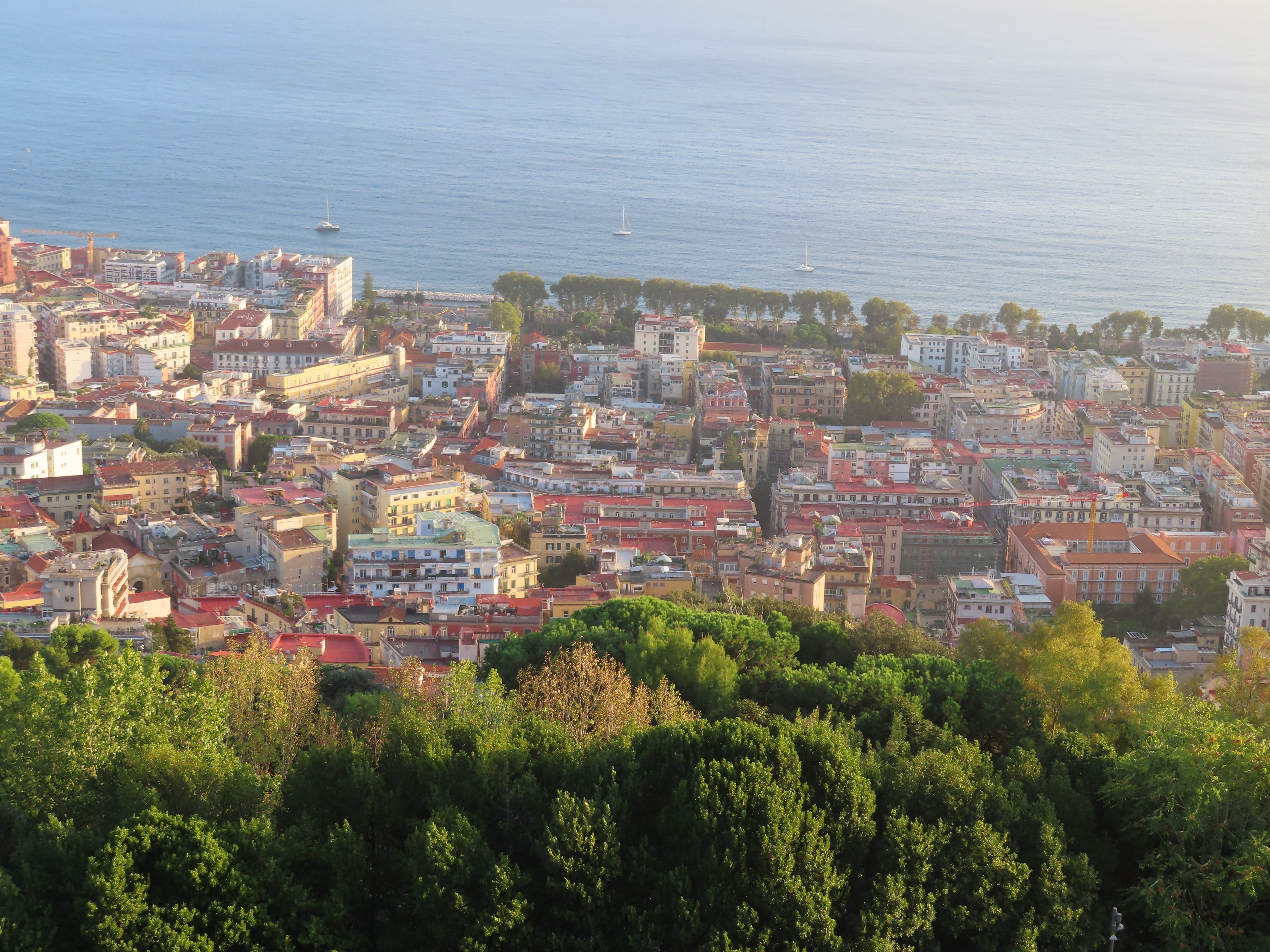
In October 2025, our group reconvened in Naples (with several new students attending and several not returning). Napoli: Paradise of the Devils, Halkyon’s second in-person event, focused primarily on medieval and early modern Italian texts: Dante’s Inferno (1321), Machiavelli’s The Prince (1532), Giordano Bruno’s On the Shadows of Ideas (1582), Giambatista Vico’s New Science (1725), and Benedetto Croce’s “Why We Cannot Help Calling Ourselves Christians” (1949). Each night, we met at Niederhauser’s rented flat in Centro Storico, Naples’ historic district, for a long dialogue on one of these texts. On most afternoons, we saw famous archaeological sites and artistic masterpieces, including the ruins of Pompeii, Caravaggio’s painting The Seven Works of Mercy, and Sanmartino’s sculpture The Veiled Christ. After the Halkyon event, I visited Rome on my own for a few days where I saw many other sites and masterpieces, including the Colosseum and the Sistine Chapel. The first subsection below discusses our philosophical dialogues, the second my travels through Naples and Rome.
An Italian Modernity
Niederhauser opened the event again with a toast, this time to “The Devil’s Paradise”—an old nickname for Naples, apparently referring to the city’s contrasting elements of vice and beauty. More pertinently, the city’s original name was Neapolis, meaning new polis (new city), in Greek. Niederhauser had called us to Naples to discuss the meaning of modernity, what the Germans call Neuzeit, meaning “new time,” signifying that the modern world has broken from the ancient world in some fundamental way. The view of modernity that dominates today, he argued, has not sufficiently taken Italian thinkers into account. Our goal in Naples was thus to learn about these thinkers and to explore how they might help us understand the modern world and chart a new course forward.
More precisely, we have inherited a Franco-German interpretation of modernity, one beginning with Descartes’ Enlightenment rationalism and culminating in twentieth-century postmodernism, originated by French thinkers influenced by Heidegger, like Deleuze and Derrida. Cartesian rationalism initiated a trajectory of thought that aimed to ground existence in abstract systems of thought divorced from real world phenomena. This is seen perhaps most strikingly in Leibniz’s Monadology and in the French postmodernists’ “deconstruction” of history. Practically, modernity is dominated by the need to find a measure—the view that only what can be quantified and measured truly exists, that calculation and optimization are the only ways that man can truly interact with reality. Everything in the natural world is thus turned into a “resource,” standing ready for man’s calculated manipulation and consumption. Even man himself is turned into a resource—a “human resource”—standing ready to serve other demands, such as profit maximization in some industry. Heidegger calls this Gestelle, or Enframing, the essence of modern technology. Ultimately, the Franco-German trajectory of thought has led to a world in which we have access to everything on demand but do not truly understand anything, resulting in the nihilism that dominates our age.
Niederhauser posited that there might be another modernity, an Italian modernity, one beginning with Dante, writing centuries before the Enlightenment, and Vico, explicitly responding to it. The Italian modernity does not “feed into” nor must it be “synthesized with” the Franco-German modernity. It represents an entirely different trajectory of thought, one not rooted in Cartesian self-reflexivity (captured succinctly by the maxim “I think, therefore I am”), in which the human subject serves as the ground of knowledge and certainty. Ultimately, it is a philosophy of contingency rather than certainty: focused on the whole cosmos rather than man, grounded in nature and divine providence rather than abstract idealism, rooted in poetry and myth rather than rational tract, and aiming simply to guide our path forward rather than to precisely control our future. How does this Italian modernity speak to us today? How does it differ from the dominant understanding of modernity that we have inherited? How can it help us chart a new course forward to escape modern nihilism? Our dialogues each night in Naples focused on these questions.
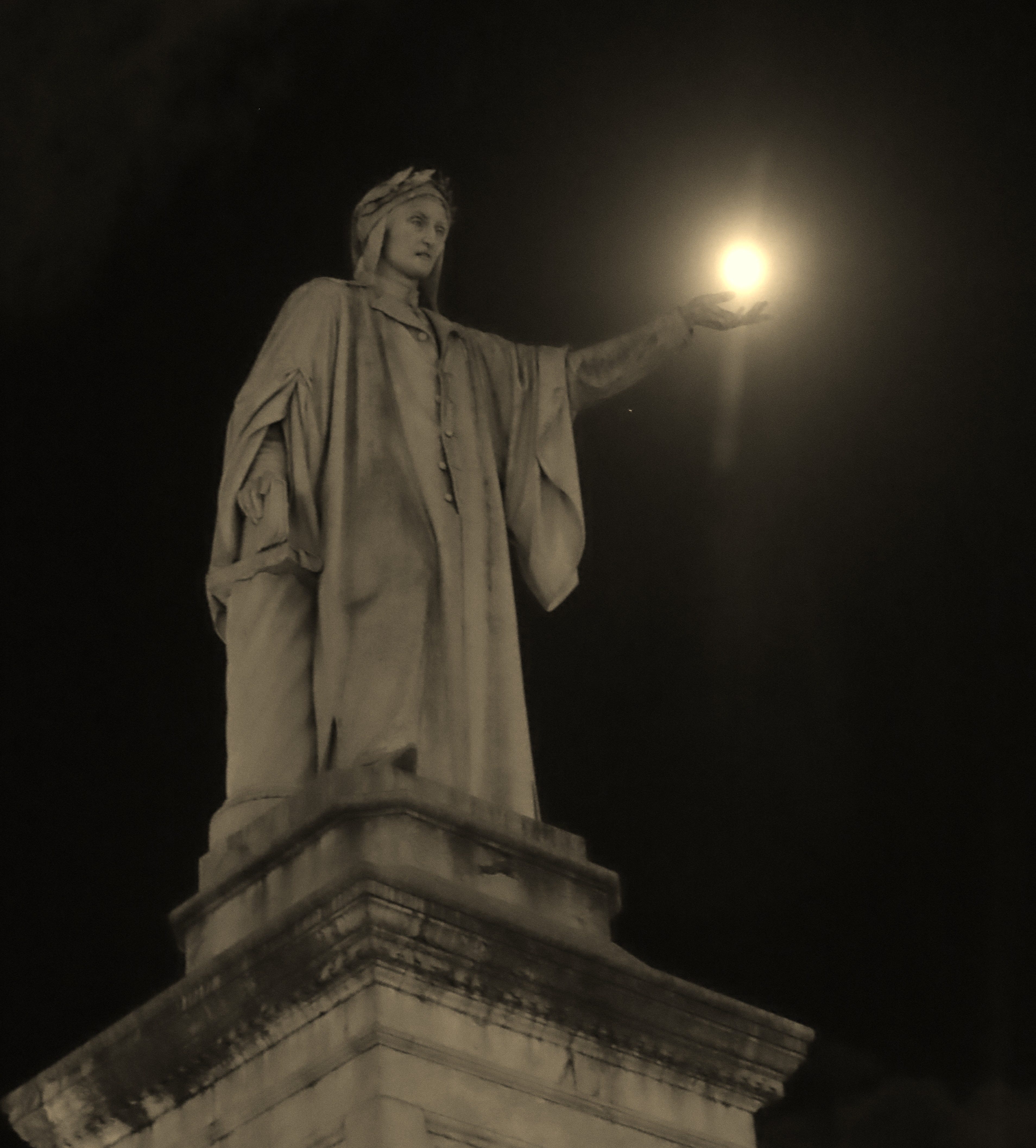
On the first night, Niederhauser led a discussion on Dante’s Inferno, the first part of his Divine Comedy (1321). Dante, the main character in his own work, begins a journey towards a divine light on a distant mountaintop. He is unable to get there directly; instead he must first descend, guided by the Roman poet Virgil, through the many levels of Hell. There, he encounters historic men, from Greek and Roman antiquity and from then-recent Italian history, being punished for a variety of increasingly grave sins. Contrary to Cartesian self-certainty, Dante teaches that we must “abandon all hope” and die a spiritual death; we must wander through the dark forest and embrace uncertainty; we must pass through Hell to get to Heaven; and we must grasp the lowest to ascend to the highest. Contrary to Cartesian self-reflection, Dante’s work is a reflection not on man himself but on man’s role in the cosmos and on the entirety of human existence.
Although Dante, born in medieval times, is not technically a modern thinker, he greatly influenced modern Italian language and thought. Moreover, he serves as a crucial link between the ancient and modern world, actively synthesizing ancient characters into his work, addressing important philosophical conflicts such as whether the universe is created or eternal, and addressing the theological crisis of the ancients: that their gods do not care for them. His response is that the Christian God does care for His followers and that He gave them a crucial role to play in the cosmos. The posited Italian modernity, possessing Dante as a formidable link between the ancient and modern world, thus stands in stark contrast to the Franco-German modernity, which is typically viewed as a sharp and deliberate break with the ancient past.
Following the discussion led by Niederhauser, one of the students presented a talk of his own titled “Dante’s Doctrine of Joy,” which analyzed the Divine Comedy holistically. It argued that for Dante, love, not reason, is the fundamental principle of the universe. Through reason, Dante attains only a lesser salvation, guided by the wise poet Virgil through Hell; but through love, Dante attains full salvation, guided by his beloved Beatrice through Heaven. For Dante, human life, despite its immense suffering, is fundamentally worthwhile and joyous. This is why he didn’t view his work as a tragedy and couldn’t help but call it the Divine Comedy. The implication, it seems, is that modern rationalism can at best provide a lesser salvation of man, but that Dante (and other Italian thinkers influenced by him) can help guide us towards a more holistic salvation, one that accounts for and affirms the entirety of human life.
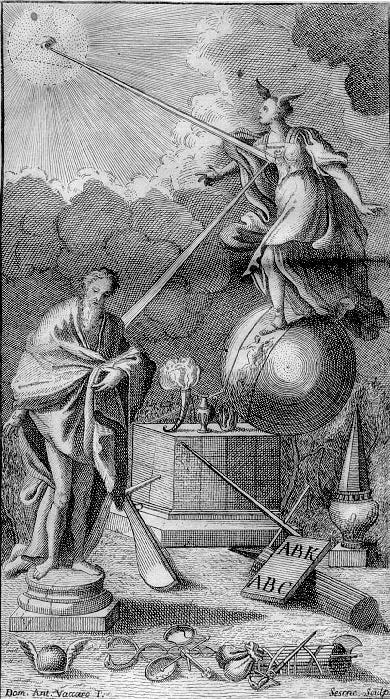
The second night focused on Giambatista Vico’s New Science (1725), a fascinating work that is not widely read today. Vico, responding to the Enlightenment rationalism emerging in his day, aimed to create a new science for comprehensively understanding human affairs. His book’s cover image (shown below), a copy of which we passed around to discuss, depicts dozens of meticulously chosen symbols, representing God, metaphysics, poetry, divine providence, nature, and various civic institutions. The image summarizes his work’s philosophical system, the symbols representing the various ways that man has sought to understand the world thus far. A prominent but narrow beam of light shines down from above, which we interpreted to mean that reason can only partially illuminate the truth. For Vico, human wisdom takes many forms. In one intriguing passage, he contrasts the rational wisdom of philosophers (both ancient and modern) with the “poetic wisdom” of the ancient (pagan) founders of political regimes. These founders possessed superior senses, allowing them to engage more deeply with nature, and superior imaginative powers, inspiring their poetry, through which they expressed a “poetic metaphysics”—a coherent, though not rational, understanding of God, nature, human minds, and our social world.3
Vico’s project is one of incredible breadth and ambition. It is unlike anything that scholars take up today, Niederhauser noted. As he put it: Vico’s work melds together the factical-historical with ideal philosophy and uses that to guide us through the dark forest before us. Human events are shaped by unpredictable factors, not solely by (predictable) rational laws. There is no way to fully light the future; the future is always a dark forest. But it is one which we can intelligently guide our way through via a holistic account of human affairs. As I discuss later, I believe that we today are in need precisely of a (modern) holistic account of human affairs. Can Vico’s work provide inspiration for such a project? Are scholars in our movement, operating outside of mainstream institutions, the ones to take it up?
The third night focused on Giordano Bruno’s On the Shadows of Ideas & The Art of Memory (1582). The work, as its title suggests, has two aims. First, it enhances classical Memory Palace systems for memorizing long lists of items. In these systems, each item is associated with a familiar place, such as a location in one’s house, and a striking, easily remembered image.4 Bruno presents a novel method for generating many such images by combining simple parts to form complex scenes, such as: “A man sitting at a table while his wife is in labor, attended by two midwives.” Second, it explains Bruno’s view of ultimate reality and how the human mind can comprehend it. He gives a Neoplatonic account: Truth emanates from the light of God and universal Ideas (or Ideal forms); their shadows are particular forms in the natural world; their shadows in turn are our cognitive representations of them.5 Truth (or ultimate reality) is thus accessible, albeit imperfectly and indirectly, to one who is able to clearly “see” and reason about the shadows of Ideas that have been sequentially impressed upon his mind. It is primarily for this task, not for utilitarian information recall, that Bruno designed his art of memory. The art, he claims, strengthens the mind, helping it hold still and hence more clearly “see” the impressed shadows.6
Bruno, like Vico, is not widely read today. Our group discussed several ways that his thought is relevant to contemporary concerns. First, Bruno’s Neoplatonic ambition was critiqued. It was linked to technologists’ ambition today of creating an “AI god,” particularly, the popular belief that LLMs will lead to AGI. Bruno attempts to ascend from the shadows of Ideas cast on the human mind up to ultimate reality. LLMs attempt to ascend from an even further indirection of shadows—statistical patterns in large text databases, themselves shadows of human cognition—up to a degenerate form of ultimate reality—God as mere intelligence. Second, Bruno was influential to many modern thinkers who laid the philosophical foundations for our times. He was one of the first, for example, to not only propose the idea of a decentralized, infinite universe—one not geo- nor heliocentric, nor created by God at a specific time—but also to draw out the profound philosophical implications of this cosmology. In particular, that man loses his privileged place in the cosmos, which some students argued was the seed of modern nihilism.
Later that night, we briefly discussed Machiavelli’s Prince (1532) and its relevance to contemporary politics. Machiavelli, casually interpreted, advocates realpolitik: he articulates many realistic yet unpleasant difficulties that rulers of principalities encounter, enumerates possible ways to deal with them, and advocates or opposes each choice guided not by a priori moral commitments or abstract ideals but instead by historical examples of what actually works to maintain political power. He upholds, for example, the ingenious maneuvering of Cesare Borgia that reduced his crime-ridden principality to peace and obedience to his rule. Borgia employed another man to mitigate the crime by enacting cruel punishments, like tortures and public executions, a strategy that, while effective, incidentally bred hatred. To quell the people’s hatred and win its loyalty, Borgia had the man killed and his body, split in two, displayed in the town square.7 Regarding Machiavelli’s contemporary relevance, many students interpreted his teachings as advocating the raw pursuit of power, with some attempting to draw parallels to contemporary geopolitics, critiquing American foreign policy as unmoored from the nation’s founding ideals, a view that some European students had presented in Athens, as I touched on earlier.
On the fourth and final night, we discussed Benedetto Croce’s 1949 essay “Why We Cannot Help Calling Ourselves Christian.”8 “Our thought inevitably works on the lines laid down by Christianity,” Croce writes. “We are forever struggling to mediate between bitter opposites”—morals and expediency, liberty and authority, heaven and earth—navigating social tensions that reflect a characteristically Christian understanding of man and his inner struggles. But we are not merely the intellectual heirs to an antiquated Christian worldview. Instead, “we feel ourselves literally children of Christianity,” the inexorable heirs to the greatest revolution in human history, one initiated by Jesus but that (necessarily) unfolded historically, advanced by humanists, theological reformers, philosophers, and other “workers in the Lord’s vineyard,” one that we today have a unique role to play in advancing. The decline in religious enthusiasm today, Croce councils, is perhaps “less a death than a hidden and protected seed which will germinate and throw out new shoots,” a process that we must tend by cultivating the fire of Christian sentiment.
While I do not, in fact, call myself a Christian, I found Croce’s work insightful. It would be interesting, for example, to compare his view that the decline of Christianity today is only apparent, perhaps even a necessary stage leading to its expansive growth, with Nietzsche’s declaration of the death of God. Croce’s work also reminds us that philosophers, who are often viewed as rational enemies of Christianity today, once played a crucial role in advancing it, and leads us to wonder if they may do so again in the future. The work provided a nice conclusion to our investigation of Italian modernity. Might the Italian trajectory of modern thought be uniquely capable of synthesizing Christianity? If so, why? Is it due to its intellectual roots beginning with Dante? Or perhaps to the country’s unique history with Rome and the Catholic Church? More broadly, the work leads us to ask how we today are inextricably bound to what has come before us.
My Italian Journey
My ancestors fled a country seeking economic opportunity. I fled economic opportunity seeking a country. America, the land my ancestors came to, the land I grew up in with my siblings and cousins, around grandma’s pizza and swimming pool on New York summer afternoons, would never again be my home. This, I was promised at university. It was the prospect of this terrible fate that animated me to flee institutional comfort and set out on a lifelong cultural-intellectual journey through the great books and in search of a community that could ultimately help me escape it. It was this journey that, for seven short days in October 2025, led me for the first time to Italy, the land my ancestors had left one hundred years ago.
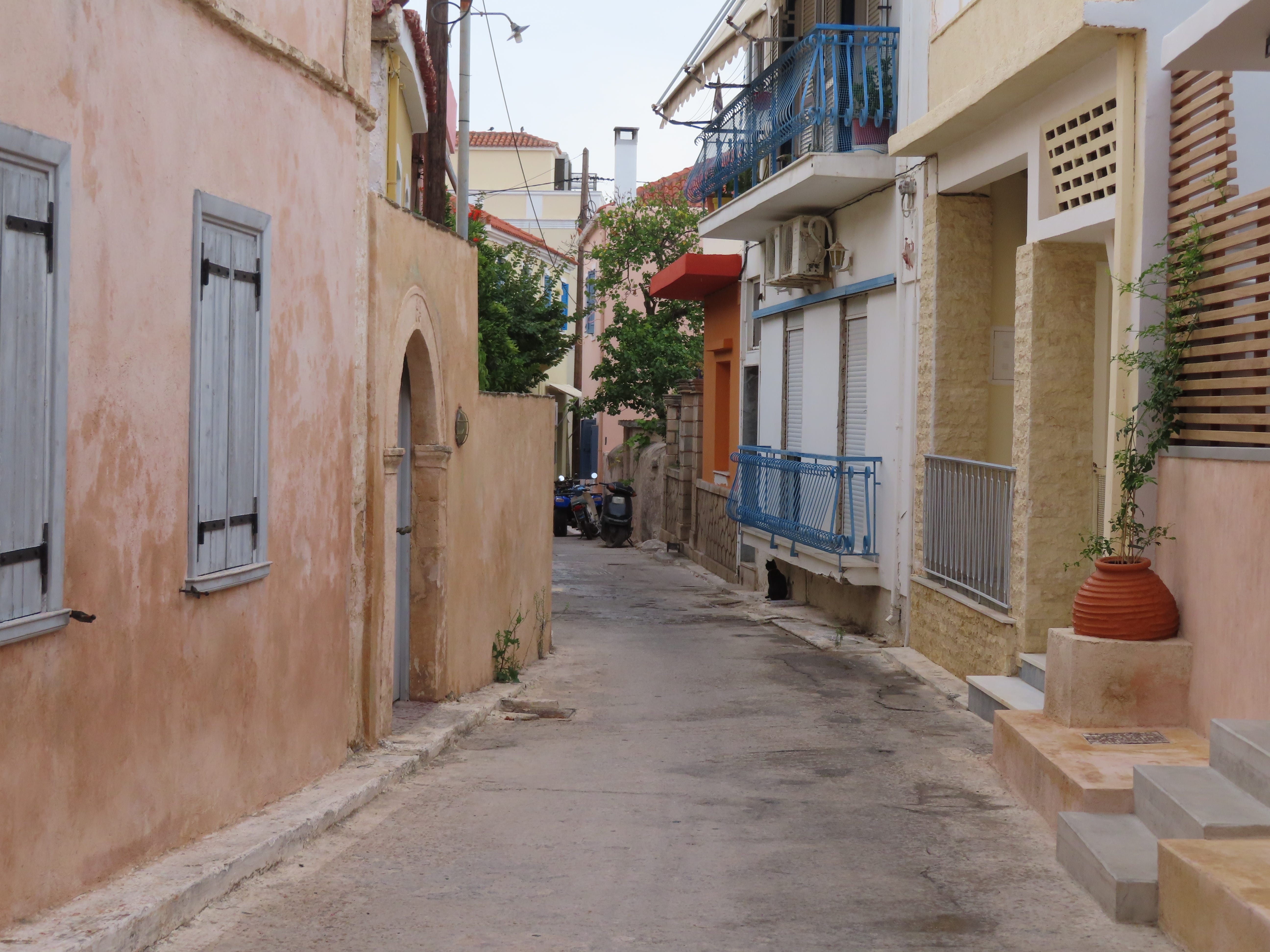
I landed in Naples the night before the Halkyon event and took a taxi to Centro Storico, the city’s historical center. Dodging speeding mopeds and compact cars barely narrow enough to fit through its main street, I walked among the crowd of locals on their way to the little shops, restaurants, and convenience stores that lined it. I cobbled together enough Italian from my middle- and high-school classes to get directions to Vico Giganti, the “avenue of the giants,” and find my way to building number quaranta sei, my home for the next four days. From there, I departed to meet Niederhauser and several other students for dinner where we recollected our adventures from the previous year’s trip to Athens as well as the friends we had made there, many of whom would be joining us the following day.
As in Athens, we spent nearly all of our time together. Each night, we had dinner, sampling Naples’ famous pizza and other delicious food, dialogued on one of the assigned texts at Niederhauser’s apartment, and then set out to explore the city’s popular bars, where we often wound up talking late into the night. We had many valuable conversations including several that centered on the purpose and future of our movement, particularly its relationship with academia and how to build community among our geographically isolated students and teachers, as I will discuss in the next section.
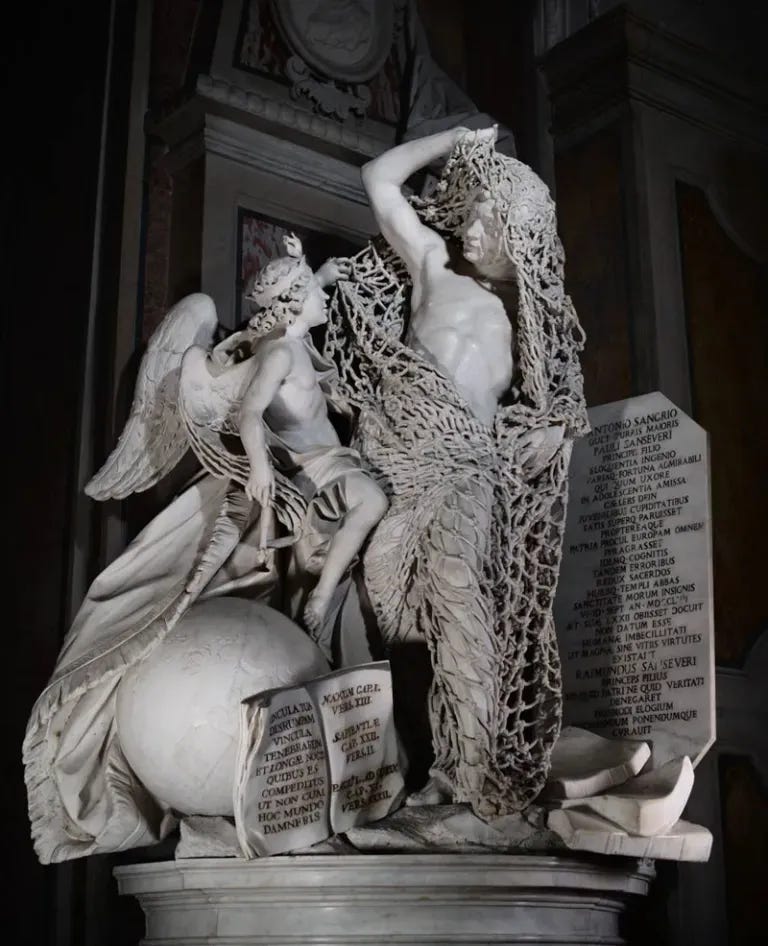
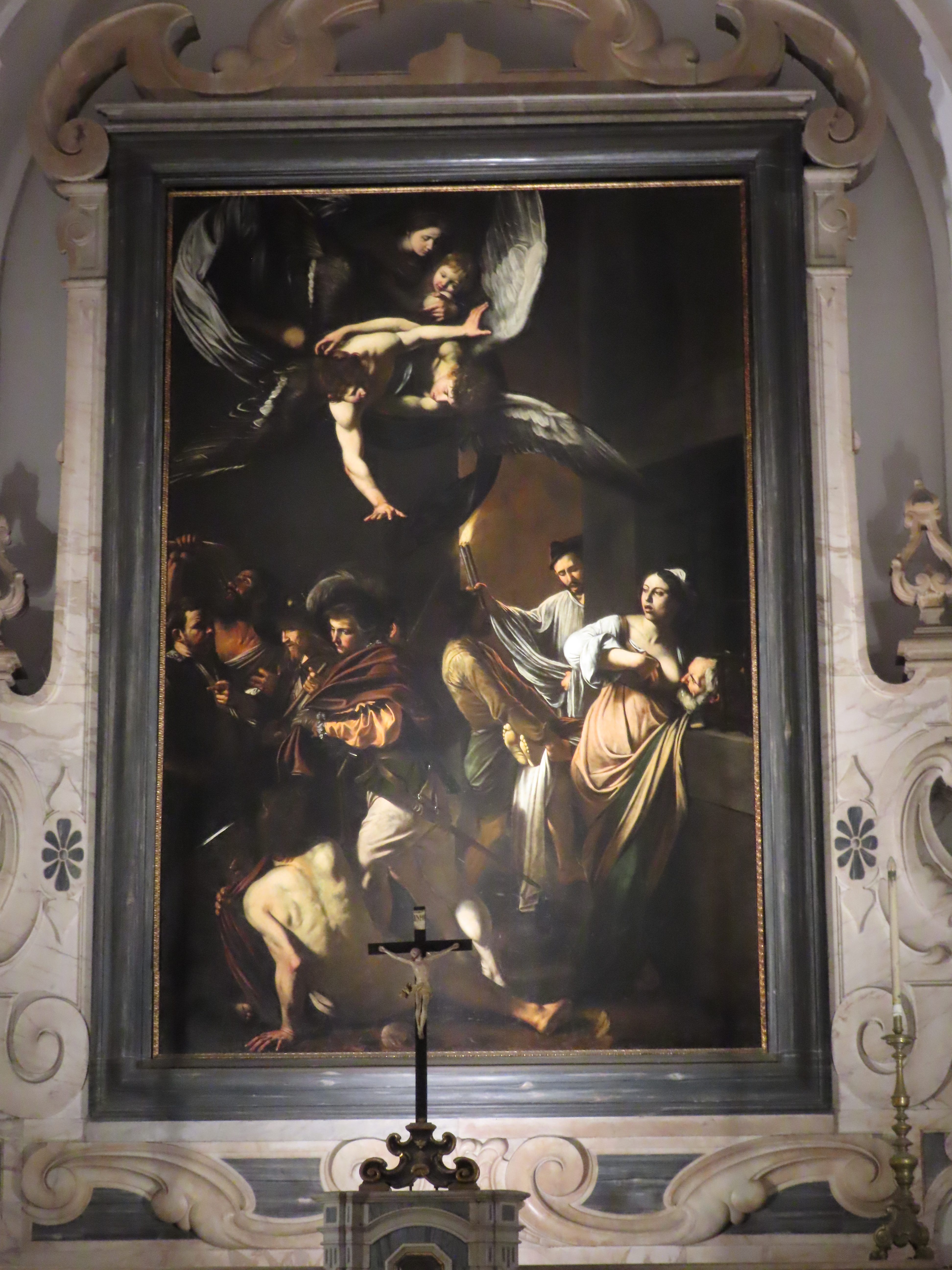
Each afternoon, we toured sites in and around the city. It was genuinely shocking to see so many incredible sites packed into such a small area. Centro Storico alone was covered with dozens of small cathedrals and churches, two of which showcased beautiful works of Catholic art centered around a world famous masterpiece. One was Michelangelo Caravaggio’s The Seven Works of Mercy, a 1607 painting that seamlessly blended together seven related but distinct scenes, each dramatically depicting an act of Christian compassion, such as sheltering the homeless. The other was Giuseppe Sanmartino’s Veiled Christ, a 1753 marble sculpture portraying Christ lying dead, covered by an almost impossibly thin veil. It was surrounded by other impressive sculptures, including my favorite, Francesco Queirolo’s Disillusion, portraying a scene containing a man caught in an intricately woven fisherman’s net, which I was amazed could be cut from a single piece of marble and rendered so precisely, down to the finest grooves in its rope.
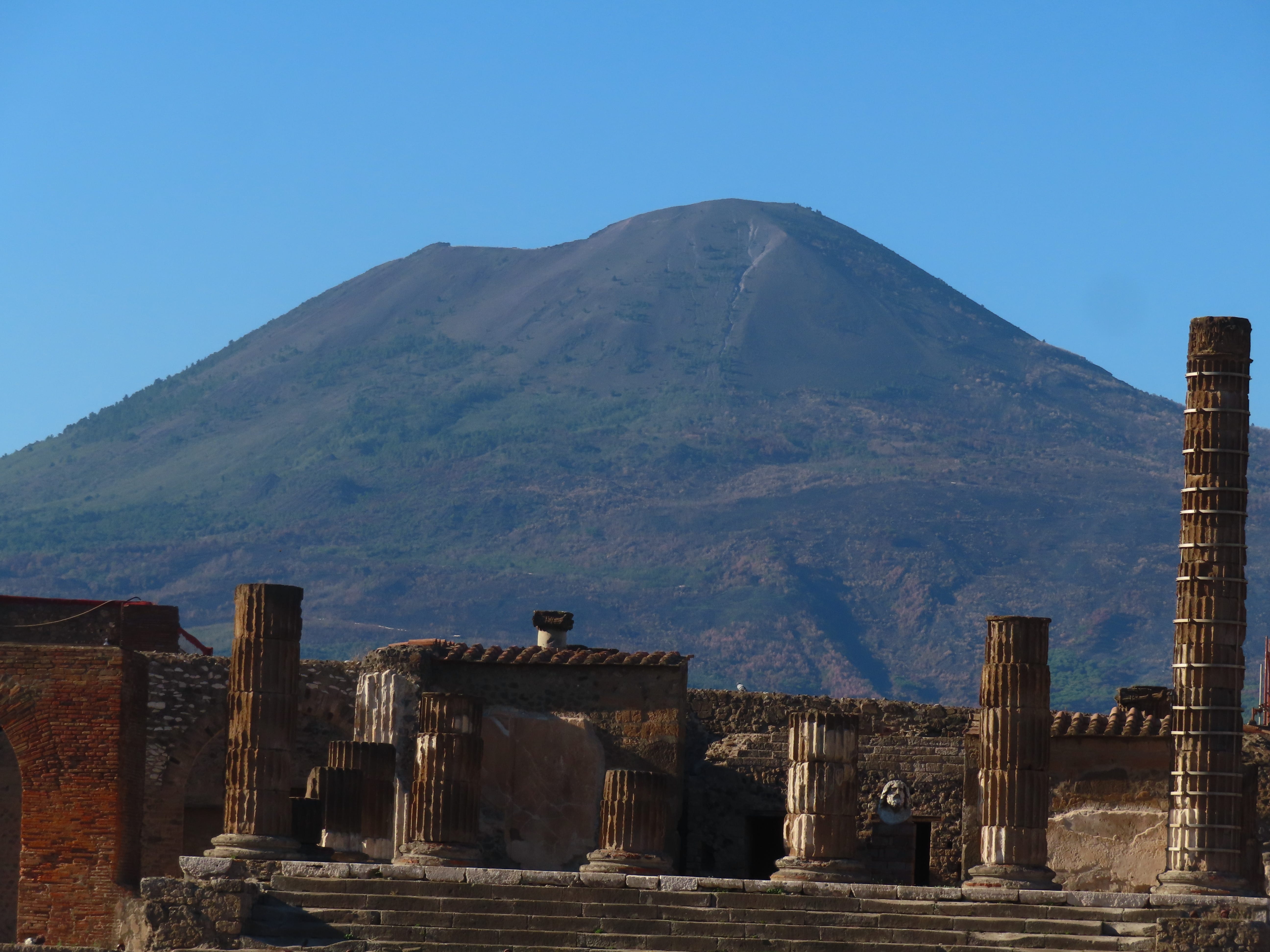
On two afternoons, we ventured outside of Centro Storico. On one, we took a train to other side of the city to see the Castel Sant’Elmo, a large medieval fortress equipped with canons at its entrance and parapets cut for archers encircling its top level, around which we were able to walk and see the Gulf of Naples and much of the city. The other afternoon, three other students and I took a taxi to Pompeii. The ancient city, buried in hot ash from a volcanic eruption in 79 A.D. and excavated in recent centuries, was one of the most incredible sites I’ve ever seen. The remains, preserved in remarkable detail, gave me the haunting feeling that I was walking through the city exactly as it had been on that fateful day: its stone streets still bore the imprints of iron-covered carts’ wheels that had driven over them; houses comprising entire neighborhoods still stood; paintings covering their interior walls had retained their vibrant colors; and citizens’ bodies, helplessly-posed in their final moments of life, had been frozen forever in plaster casts.9
Unlike in Athens, the sites that we saw in Naples were not directly related to the philosophical texts that we had read for the event. So what did I gain from seeing them? Seeing the artistic masterpieces, especially Disillusion, inspired me as a writer, emboldening my pursuit of the craft and the slowly developed precision that it demands, something nearly lost in our chaotic age, demanding, by contrast, that we “publish or perish” in academia or compete for attention online. This incredible sculpture was possible only because the artist had devoted seven years of his life to it, and decades before to mastering his craft. Its defining feature, the intricately woven fisherman’s net, epitomized the relentless pursuit of precision: not only was the finished work rendered in remarkable detail, but the degree of care required to bring it into being, the net being fragile and mistakes impossible to undo in marble, was a constraint I couldn’t imagine working under, as I rewrite endlessly.
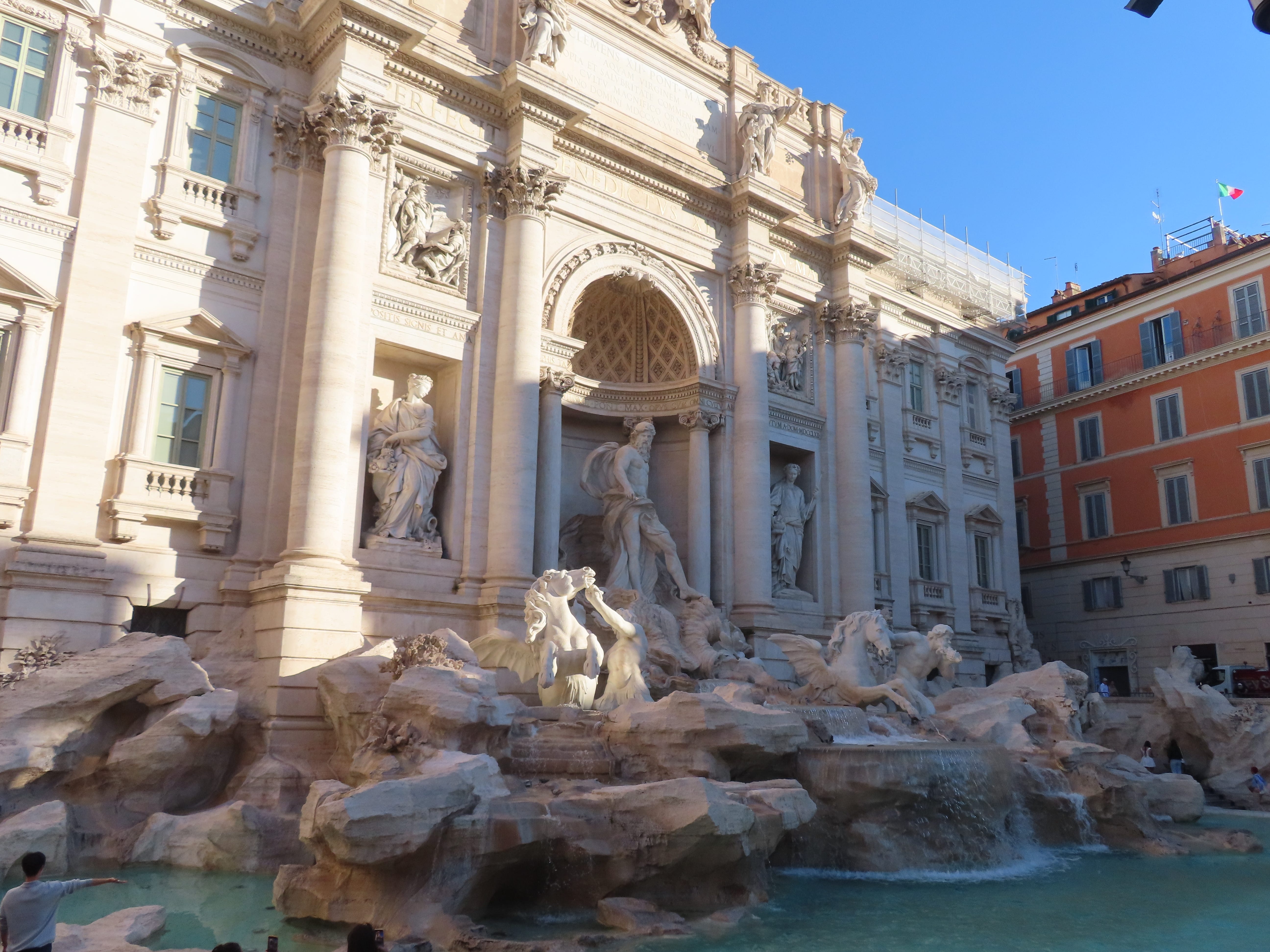
After the Halkyon event in Naples, I took a train to Rome, where I had rented a place in the city center for a few days. An intricately illustrated map of the city that came with the place would serve as my sole guide for the next few days. (I threw out my smartphone years ago.) It felt incredible to set out each day with no plans, obligations, or technological distractions, aiming only to cover as much ground as possible, picking a place on the map, walking there, getting lost, taking intentional digressions, and discovering hidden gems, before finally finding my way again.
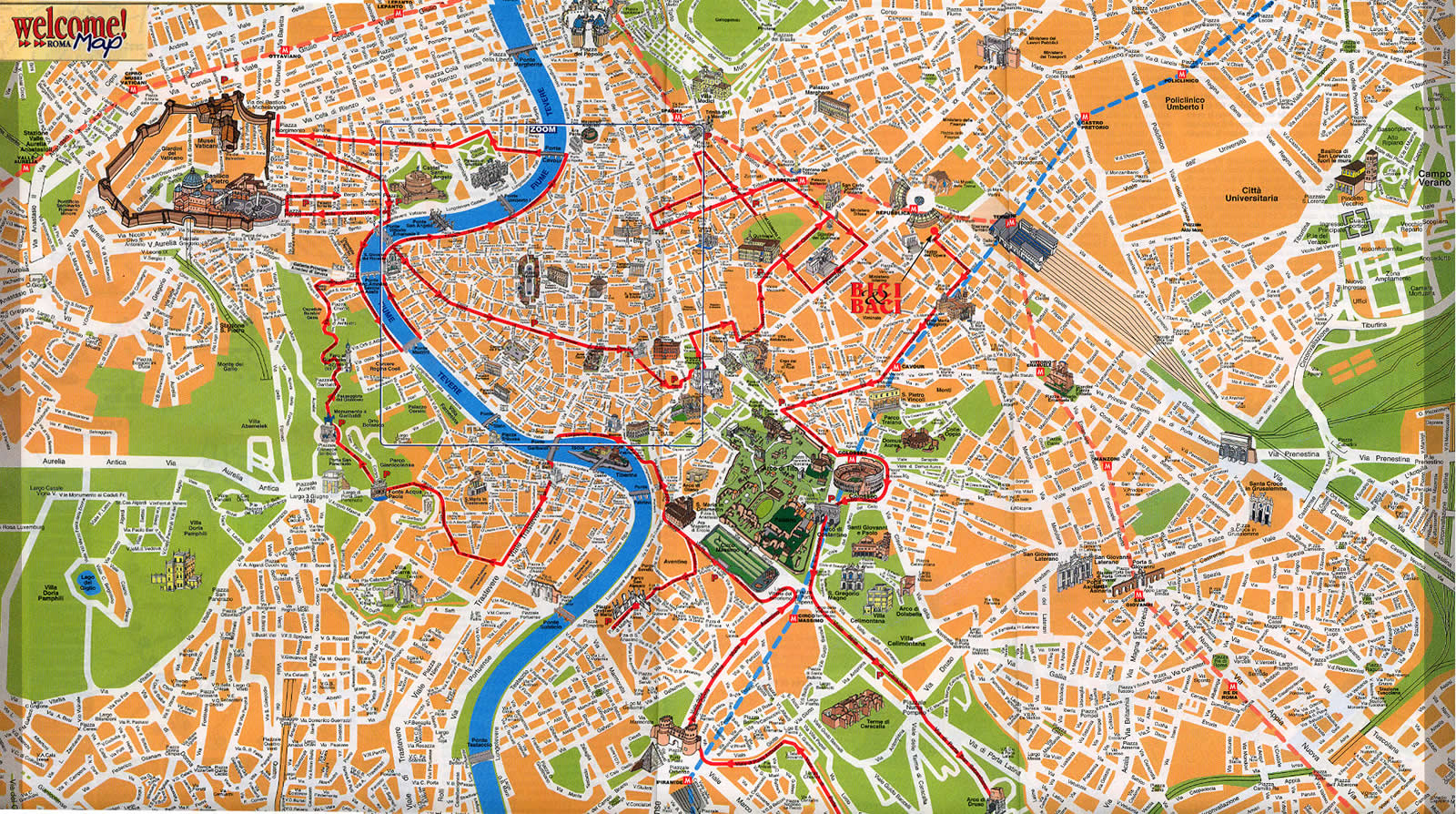
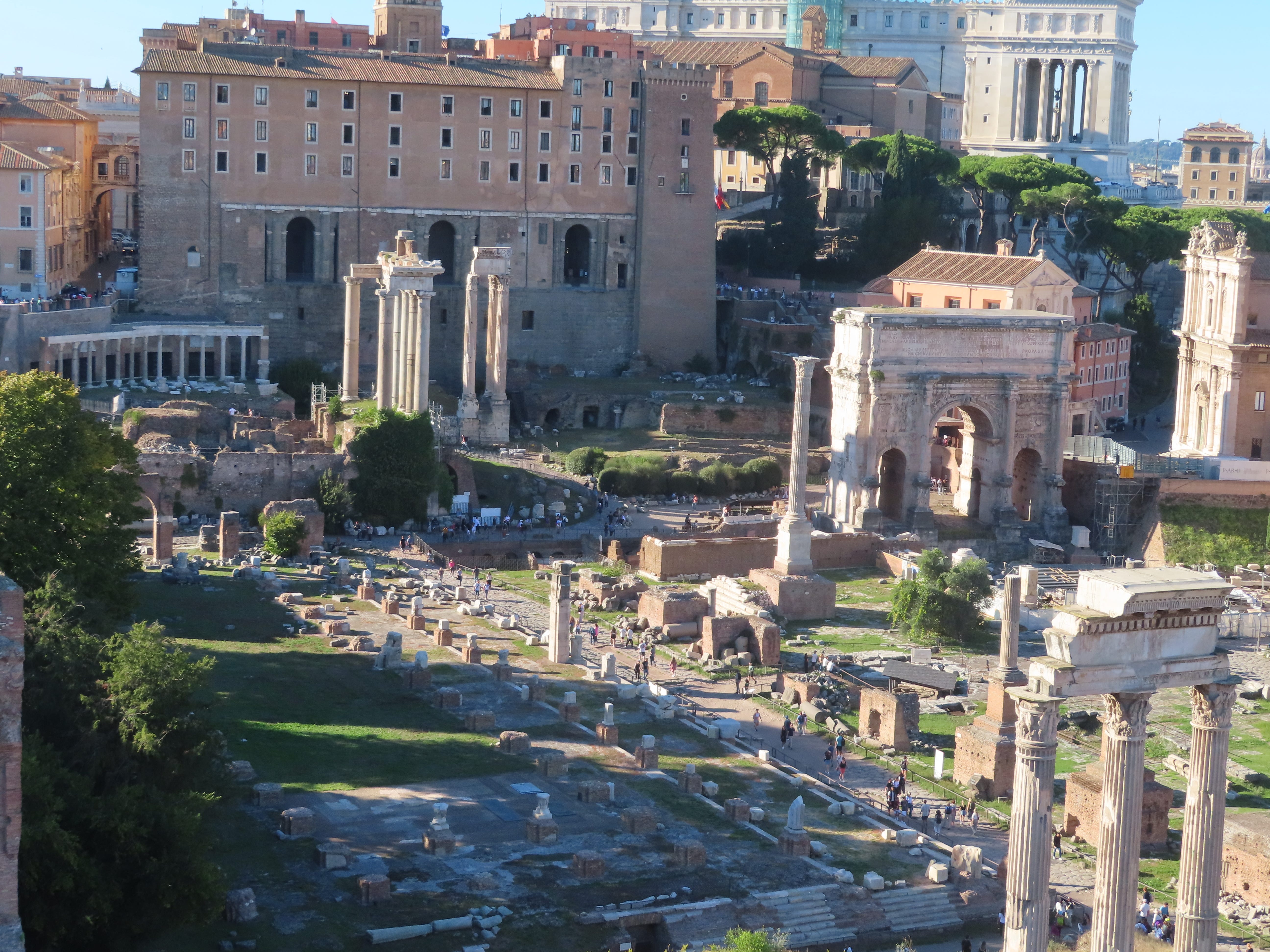
Rome was the perfect city to get lost in. Within just a few hours, I stumbled upon the Pantheon, a dome-topped church covered with Catholic paintings and sculptures; the Area Sacra, a small courtyard containing temple ruins; a small church in which a concert featuring beautiful Italian opera music by candlelight was hosted; and the Trevi Fountain, the largest of the city’s many impressive fountains, each centered in a busy piazza and adorned with intricately carved marble statues of gods, angels, winged horses, and other mythical creatures. On another afternoon, I wandered into a botanical garden at the edge of the city; a small museum housing a meticulously pieced together stone-carved map of the ancient city; and the Roman Forum, the center of ancient city life, now a vast expanse of ruins of temples, ornate arches, and other ancient relics.
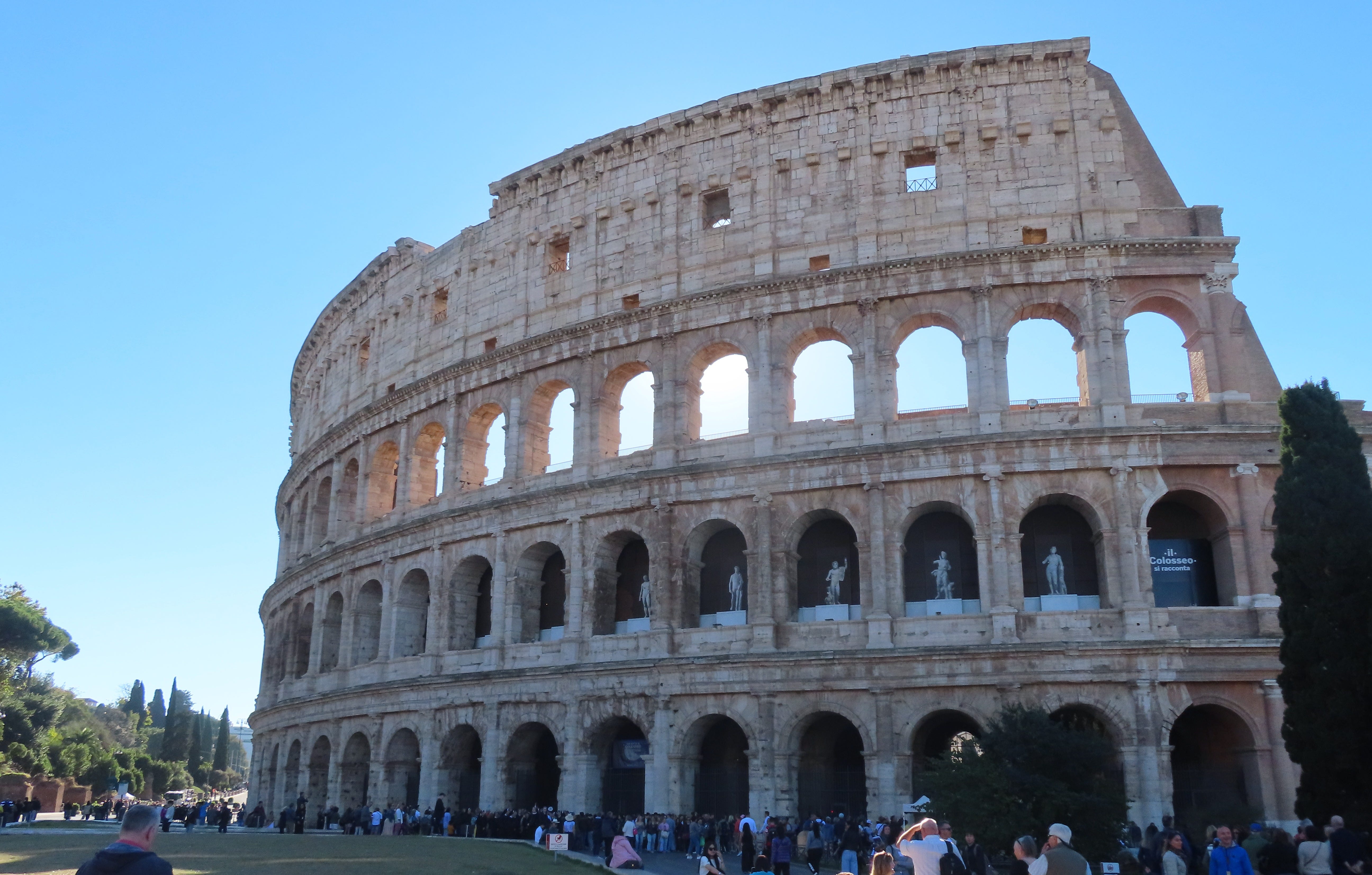
Next to the Forum stood the Colosseum, an architectural masterpiece, beautifully structured and intricately designed, worn but not broken by time, imposing itself—the haunting echo of a lost empire—on my casual walks through the city, reminding me of my civilization’s mortality and, of course, of my own. I toured the amphitheater that afternoon. Looking down from the rafters upon its central arena, I couldn’t help but envision lives being brutally ended down there and imagining the tourists standing next me as ancient spectators vulgarly cheering it on. While the Colosseum is often valorized as a symbol of martial virtues like courage and toughness, it did not strike me as a good or honorable place, not one that we should look to in our struggle to counteract the cowardice and weakness that threatens our civilization today.
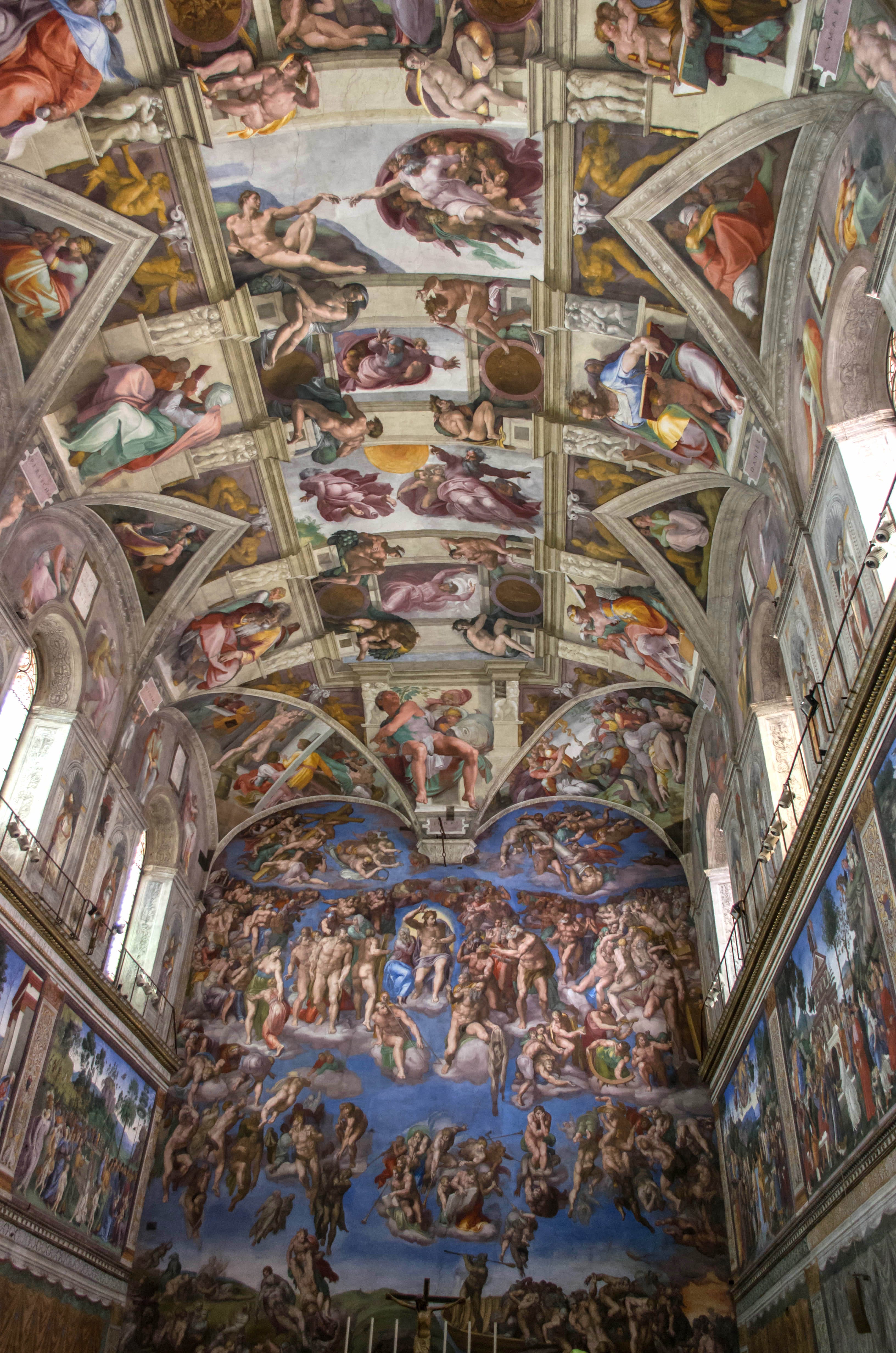
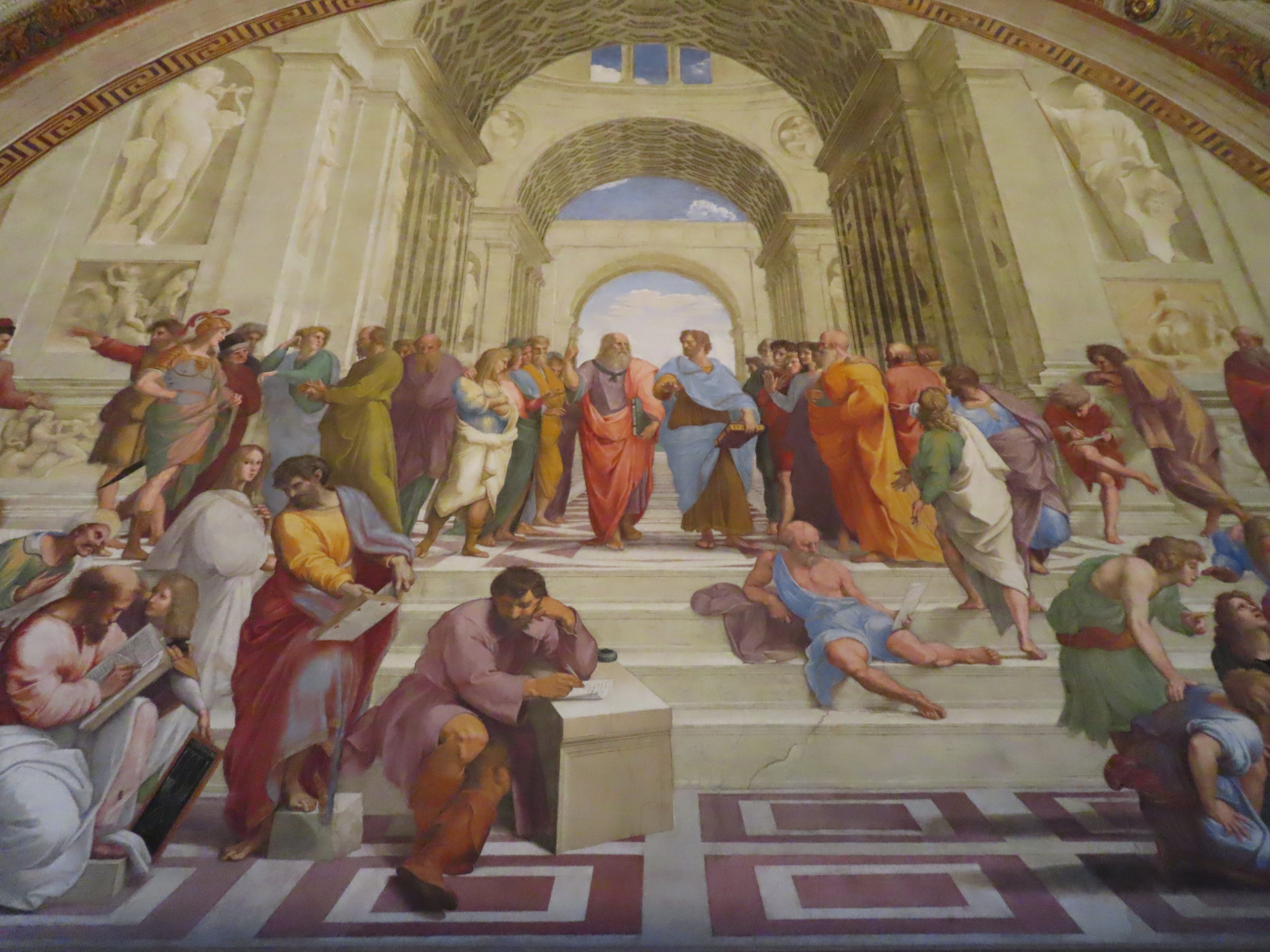
Surprisingly, as I am not a Christian, it was the Vatican Museum that most impressed me in Rome. The museum, spanning a massive network of buildings, housed many incredible works of art and ancient relics: beautiful Renaissance-era paintings that covered entire rooms, massive colored rugs woven to depict Jesus and other religious figures that lined a long hallway, ancient Roman pottery and sculptures scattered across indoor and outdoor exhibits, and several world-historic works of art. The most inspiring was Rafael’s School of Athens, the painting of ancient Greek philosophers that has become a nearly universal symbol of philosophy itself, as it was particularly relevant to this trip and to my intellectual mission.
The most thought-provoking work was Michelangelo’s masterpiece painting covering the Sistine Chapel,10 at which I stayed for more than two hours viewing and contemplating, gradually beginning to grasp the work itself as well as the many underappreciated factors in its creation and preservation. It was a unique experience to not just see a great work of art but to be completely surrounded by it. Looking up at the fingers of God and Adam touching, a depiction I had seen countless times in photographs, I couldn’t help but envision Michelangelo right above my head five hundred years ago bringing it to life, famously taking four years to complete the ceiling and temporarily sacrificing his eye sight to do so. The unlikely conditions under which I stood there also came to light: between the artist and me stood an unbroken chain of men stretching across centuries, preserving and protecting his work through wars, political upheavals, natural decay, disasters, and would-be vandals and connivers of every sort.
This realization was inspired not only by Michelangelo’s work but by the shocking behavior of my fellow spectators. In the holy Chapel, it was forbidden to talk or take pictures, a regulation that few respected and many brazenly transgressed. Herds of grown adults and senior citizens continuously trampled through, garishly lifting their smartphones into the air to steal pictures of the ceiling, ducking into the crowd and doing so to avoid being caught, holding their phones at waist-level in selfie-mode to grab the shots and giggling at their stealth transgressions, and, if caught, mocking with their friends the security guards who spent their time doing little more than desperately threatening transgressors with expulsion and sounding “Silenzio! Silence please!” over the loud speaker every five minutes to quell the voices that refused to even whisper.
It was the first time not only that I had been surrounded by a great work but that I had truly watched the many view one. It was an indictment of our culture: worse than being unable to produce great works, it is unable to even produce worthy spectators. The Chapel to them was not a work to admire or aspire to; it was merely a famous object and a smattering of pretty colors on the ceiling, two forces compelling them to capture its image and share it online—an act of techno-piety that chapel authorities had no right to interfere with. As writers and artists today, we often want to have large audiences, on social media and elsewhere, to feel like we are having an influence, one that will hopefully last even after we are gone. But would we really want such an audience if we knew that our work would be consumed in this way? What would Michelangelo think if he could have seen the chapel that day?
Our movement today to combat the degradation of high culture must carefully consider its relationship with the many. While the Greeks may have been right that the many cannot be made wise, they should at least be made to respect great works (of both art and philosophy) or else be aggressively barred from participating in them. As we exit academic institutions, we must not degenerate into an isolated intellectual subculture. We must instead build a strong community of scholars, artists, and civic allies who will thoughtfully engage with great works, provide an environment conducive to the production and display of new works, and strive to subdue the vulgarity in the wider culture that threatens our important mission.
The Fate of Western Civilization
The previous two sections discussed my trips to Athens and Italy. This section discusses Halkyon in the context of our wider movement, focusing first on its educational and then on its communal development. The first subsection, drawing on discussions with Niederhauser and other students at the events, discusses Halkyon’s educational vision, shedding light on two key aspects of our movement. First, its relationship with academia: What went wrong in academia? Why is our movement necessary? Is it in competition with or doing something fundamentally different from academia? Second, how its entrepreneurial schools are evolving: How are they teaching? What principles motivate them? What challenges are they facing? How can they be improved?
The second subsection, drawing on my experience with Halkyon and other groups, describes movement, its historical evolution, and the factors influencing its deeper communal development. As I see it, a new “polis“ is forming: a vibrant cultural-intellectual community, operating largely outside of mainstream institutions and big city power centers, that is dedicated, in both scholarly and civic capacities, to confronting the ills of modernity and discovering a more authentically human way of life. This emerging community, I believe, is necessary to address the cultural and educational crisis threatening the West. I sketch out this vision as well as how Halkyon’s philosophical investigations of modernity might fit into this project.
Authentic Philosophical Inquiry
In Athens, Niederhauser said that he had founded Halkyon to help revive authentic philosophical inquiry, which has deteriorated in academia. In Naples, he discussed his educational vision further. He emphasized that he does not have a strictly negative view of academia, that he believes there are still some scholars doing good work there. He rejected the view, held by many critics of academia, that its core problems are political. If the universities were put under conservative leadership, in an attempt to mitigate DEI persecutions and progressive bias in scholarship, they would still have the same fundamental problems, which are structural and bureaucratic.
Founding Halkyon has allowed him to overcome some of these problems. University professors must “publish or perish,” while he can write what and when he pleases. Most university students are motivated by degrees and career advancement, while most Halkyon students are motivated by their love of philosophy and learning. Professors pretend that they are free from market demands but in practice must treat students like customers and “make the customer happy”; ironically, although Halkyon technically has customers, not students, he is able to run his classes more freely. In academia, scholars are often pigeonholed into a specialty early in their careers; a Heidegger scholar, for example, is rarely given the opportunity to teach Dante, as he did in Naples. Academics have little flexibility in choosing where they live, but his online school has allowed him to live and travel where he pleases. Many professors do not have amicable relationships with their PhD students, but he is friends with many Halkyon students, a dynamic that facilitated these memorable trips.
While independent schools have many advantages, Niederhauser rejected the view, held by some in our movement, that they will one day come to replace universities. To do so, he argued, they would have to become institutions themselves, but would then suffer the same problems. Instead, these schools should remain independent and work to influence the thinking within existing institutions. During dinner on the final night in Naples, a Halkyon student, who is currently pursuing a philosophy PhD at a prestigious English university, expressed a complementary view. He does not believe that independent schools and established universities are in competition but rather that each provides something unique. Graduate school allows him to consistently share his work with his peers, soliciting their critiques, and to teach undergraduate classes, honing his understanding of fundamental texts. Halkyon, on the other hand, provides exposure to ideas that are unfashionable or suppressed in academia, access to unique educational experiences, such as our Athens and Naples trips, and the excitement of being part of a nascent educational movement, one that we have the power to shape and innovate within over the coming decades.
We discussed several ways that independent schools could be improved, particularly through adopting a hybrid digital-in-person paradigm. Relationships between students are often sparked at annual in-person events but they also often fade when people go home. Schools should connect students online throughout the year, perhaps by hosting weekly reading groups or organizing collaborative projects, as many graduate schools do. Additionally, the event model pioneered in Athens and Naples could be extended in interesting ways. Rather than cramming all textual discussions into four days (in addition to our site seeing), we could host preliminary seminars online in the weeks leading up to the event. This would introduce students to the texts, give them time to reread sections that came up during the discussions, and allow their initial ideas to ruminate and develop over weeks. This would facilitate deeper conversations at the event and perhaps inspire students to prepare short presentations for it.
How else can independent schools in our movement be improved? Halkyon’s events were the first that I had attended with a group that I had studied with extensively online beforehand. They thus provided a unique opportunity for me to directly compare the value of the group’s pedagogical practices—particularly, dialogue and close reading—in both online and in-person settings. I first describe what I see as the principles motivating these practices and then compare my experiences with them in each setting.11
Halkyon’s pedagogical practices are motivated, in my view, by its overarching goal of reviving authentic philosophical inquiry. Dialogue, as Niederhauser discussed in Athens, contrasting the practice with that of academic lecture, allows the group’s discussions to go in unpredictable directions, often yielding unique insights and fruitful directions for future thinking. Dialogue is also central to the Greeks’ conception of philosophy, of wrestling with contradictions that arise and enriching our understanding of fundamental questions, rather than demanding immediate answers as many do today. Close reading, on the other hand, focuses detailed attention on primary texts, aiming to truly understand the thinking process of great philosophers, as I discussed in my essay for Halkyon’s Being and Time course. Academia today too often trains students who have barely read Kant, for example, but know what is fashionable to cite and to say about him. Close reading is also motivated by Niederhauser’s belief that English philosophical scholarship has been distorted by crude translations of key terms, like Heidegger’s Gestelle (Enframing) or Plato’s dikaiosune (justice), and that his insight, as a native German speaker who also speaks some Greek, guides students to a more accurate understanding of key passages.
Both practices (dialogue and close reading) were better in person but for different reasons. The in-person dialogues felt more alive. We met as fellow travelers, at a mutual friend’s (temporary) home, sitting in a circle, seeing each other’s actual faces and bodies—not as strangers on a Zoom call, alone in our rooms, eyes fixated perpetually forward on collages of digital faces and avatars. The conversation flowed much better. It was easier to interject an idea or to see the spark of one in someone else. Our demanding three hour dialogues were eased by breaks for food, drink, and lighter conversation. We were immersed in our own world for four days. Our dialogues and informal discussions (as we explored the city) blended together into one long, continuous conversation, as opposed to many isolated ones scattered across weeks. Being part of a larger trip also made the dialogues feel more important. I was inspired to more actively listen, take notes, and write this detailed article about them—to better understand the discussions myself and to relay our groups’ insights to others who may be able to learn from or build off of them. During this process, however, I sometimes had trouble summarizing a dialogue’s central thread of thought or the key ideas of its seed text, as the discussions often did traverse so many paths. I think that the practice could be improved by allocating time at the end for the group to summarize and reflect on the dialogue.
Our close reading of a passage from Aristotle’s Nicomachean Ethics in Athens (the only one we did on either trip) was one of the most valuable short educational exercises I’ve ever done. We broke off into groups of two and dissected the passage line by line, interpreting each sentence and key word, comparing our different translations and resulting interpretations, asking each other questions about the text, working through them together, and comparing our annotations on the page: How did my partner mark the text while reading it beforehand? What was important to him? What did he underline and write? Did I “star” the same quotes as he did?—How exactly is he reading? Perhaps I found this exercise so valuable for two reasons. First, going through the text with another person—especially in person, with a pencil and book in hand, immersed in the actual phenomenon of reading—helped me become a more precise reader, which is one of my main goals. Second, studying alone is isolating. Here, I finally had a teammate to work with: a kindred spirit, someone who diligently reads these books in his home as I do in mine on the other side of the world, someone who also felt called to travel to Athens, and further called to intensely focus on this one page with me.
The need to form stronger community is, in my view, the biggest problem facing our movement. It has repeatedly come to the fore during my investigations of the movement, as it has here, analyzing Halkyon’s pedagogical practices. It is also implicit in Niederhauser’s conception of authentic philosophical inquiry—of studying the great books to understand who we are as human beings and how we should live our lives—which embodies deeply human, hence communal, rather than purely scholarly concerns. The next subsection examines the community that is evolving within our movement and asks how we should guide its development forward.
A New Polis
The movement began in the late 2010’s, animated broadly by two opposing sentiments. Negatively, that academia had stifled intellectual inquiry via its aggressive embrace of DEI dogmas and its stultifying “publish or perish” ethos. Positively, that the internet and social media had enabled new business opportunities and ways for independent scholars to distribute their work and influence culture. From these forces, a new community emerged. Disaffected academics formed online groups and schools, of various ideological, religious, and political orientations. They include: The Halkyon Guild, emphasizing Greek and German philosophy; the Millerman School, political philosophy; Theory Underground, critical theory; The Cost of Glory and The Paideia Institute, ancient Greek and Roman history; and Indie Scholars, long-form independent writing. They taught to new kinds of student: not primarily young adults pursuing degrees full-time but rather lifelong learners, many with full-time jobs or families, supplementing their self-studies with rigorous online courses and writing programs.
This movement away from academia was paralleled (primarily, to my knowledge, in America) by a grassroots civic movement similarly concerned about education, modernity, and culture. It aims to form good citizens and authentic human beings: well-read in the great books, competent in political discourse, skilled with their hands, at home in nature (away from modern technology), and actively working to improve their local communities, which are often far from big city power centers. It too formed online groups then began connecting in person. The groups include: Meriwether Academy in Nashville, hosting men’s philosophy symposiums and outdoor retreats, with aspirations to build a boys’ school; The Savage Collective in Pittsburgh, run by a philosophy professor and a mechanic; Doomer Optimism and The Delphica Society, gathering activists from across the Western world for conferences on the above topics; and The Wagon Box Inn, a rustic resort in rural Wyoming founded to connect the movement’s geographically scattered groups.
These two movements are best viewed as complementary poles of a single movement, as I argued in my recent report on a Doomer Optimism campout at the Wagon Box Inn. Members of the civic pole are natural students for independent scholars; they provide a basis for strong community outside of institutions; they possess unique life experiences that, in dialogue with these scholars, have the potential to be turned into culturally impactful intellectual works; and they force scholars’ theory to confront practical concerns, preventing them from deteriorating into an isolated intellectual community. Moreover, groups from each pole are confronting similar communal and logistical challenges, and are experimenting with different solutions that can be shared throughout the movement.
The unique challenges that our movement faces—which our institutionally supported and purely online counterparts do not—have forced it to confront deeper questions about the nature of a healthy intellectual community and the factors influencing it. How do the quality of our relationships, the kinds of events we host, where we meet, and where we live impact us as thinkers? The Halkyon events helped clarify the importance of these questions, which my studies of other groups had only recently begun to shed light on. A future article will address these (and other) questions thematically, aiming to guide the movement’s decisions about the community and infrastructure that it is building. Below, I sketch out such an analysis for three questions.
First: What kind of communal bonds should we build? Why shouldn’t we operate as isolated thinkers online or merely become professional colleagues? What historical movements should we look to for inspiration? A 2024 Indie Scholars event at the Wagon Box Inn most directly addressed these questions. Drawing on complementary examples of nineteenth-century American frontiersmen and twentieth-century literary groups, it argued that impactful cultural and intellectual movements have often originated among small groups of close friends living nearby, highlighting the need for physical meeting grounds and for building deeper friendships, even brotherhoods, within our movement today. Halkyon’s Athens event, as I discussed above, showed me how the community of Greek philosophers might serve as a model for us today: the philosophers, immortalized in literature, were mortal men whom we could emulate; it was the deep care for Socrates, among his friends and especially his student Plato, that ultimately revolutionized the intellectual world; small, physical schools like Aristotle’s can serve as inspiration for ours; and we can learn from the Greeks’ explicit teachings on friendship and philosophic community.
Second: What kinds of events should we host? Why shouldn’t we just meet in a lecture hall to discuss philosophy? How do specific events and venues impact us as thinkers? Many groups have hosted events in nature, seeing it as an antidote to the ills of the digital world and as an important intellectual influence: the Wagon Box’s events near the Bighorn Mountains see nature as an essential, even divine, source of inspiration for producing beautiful works; Meriwether’s in the Tennessee wilderness draw inspiration from Transcendentalists, such as Emerson; and Theory Underground’s on a farm in northern Idaho inspire its philosophical investigations of nature. The Halkyon trips, by contrast, were set in cities but brought us to unique historical sites. This impacted me in a number of ways, as I discussed above: the ancient sites, especially Pompeii, made my connection to the West’s ancient past feel more real; the sites in Athens helped me better understand the community of Greek philosophers; the artistic masterpieces in Naples and Rome inspired me to hone my craft as a writer; and my unexpected encounter with the vulgar spectators in the Sistine Chapel inspired me to reflect more deeply on our movement’s civic allies and our relationship with the wider culture.
Third: Where should we ground the movement? Which cities should we live and host events in? Where will we find people most receptive to our thinking? Conversely, how do our countries, cities, neighbors, and local environments influence our thinking? Our intellectual movement away from mainstream institutions has also been a geographic movement away from contemporary power centers, like New York, London, and Silicon Valley. This is evidenced by the movement’s activity not just in rural areas but also in smaller cities. Meriwether, for example, has quickly built a strong in-person community in Nashville, capitalizing on cultural shifts that have brought many advocates of classical education, including me, to the city. Halkyon’s trips to Athens and Naples as well as Niederhauser’s recent relocation from London to Italy, motivated in part by the more vibrant intellectual culture that appears to be emerging there, also evidence this geographic shift. The trips further highlighted Halkyon’s distinctly European character: its European basis logistically facilitated these memorable trips; its European roots influence its philosophical investigations of modernity, as I discuss shortly; and conversations on these trips helped me recognize that our movement may develop distinctly European and American poles.
What will be the ultimate impact of our movement? In the coming years, I expect it to grow: more online schools will be founded, more local groups will be established in small cities across America and Europe, more properties dedicated to connecting the movement will be built, and more people will move to and regularly travel to these cities, venues, and other locations for events. Further, I expect it to not just grow but evolve to a new phase. From the late 2010’s to early 2020’s, people operated largely online in isolated groups; beginning around the mid 2020’s, groups began connecting in person, collaborating with other groups, and laying plans for longer-term projects; entering the late 2020’s, the movement will, I believe, begin producing impactful books and other publications as well as influencing larger scale educational change. Each group has something unique to contribute to this decentralized intellectual project. Each has a distinct spirit and leader, attracts different kinds of people, is grounded in a different location, reads different books, has a distinct view of modernity, and is uniquely positioned to address some of its problems. Halkyon, I believe, is uniquely devoted to developing deep philosophical critiques of modernity through rigorous study of a wide variety of European philosophers.
The Athens and Naples trips alone provided many ideas that could serve as the basis for further investigations. Can we form a comprehensive picture of the ills of modernity, building off of the events’ discussions on Enlightenment rationalism, the dominance of the scientific mindset, the utilitarian distortion of the good, the demand for certainty over contingency, and nihilism?—What characterizes the Italian trajectory of modern thought? How can we build off of it today? Can Vico’s New Science, in its broadly scoped analysis of humanity, serve as a model for our movement’s core intellectual project outside of mainstream institutions? What other thinkers provide similar insights?—Can we relearn authentic philosophical inquiry from the ancient Greeks and their dialogues? What can the pre-Socratics teach us about modernity? How is our view distorted without them?—What line of thinking has the capacity to stop the march of technological domination today? Can the ancient Greeks or Heidegger guide us? Should we follow his project of inaugurating a new beginning to philosophy? If so, how might we, as human beings, be fundamentally changed by it?
At the dawn of our movement we are confronted with many questions. Ultimately: What thinking does our civilization and age demand of us? And what community do we need to build outside of mainstream institutions to do it? Halkyon’s trips to Athens and Naples brought me for the first times to Europe, helping me connect with the cities and thinkers of our ancient and early modern past. They provided important insights into these questions and helped me better understand the role I might play in advancing our movement and its evolving mission.
Eros is a daemon (202e-203a); Eros philosophizes (204b)
The cell was surprisingly simple, just a small cave enclosed by iron bars. After the trip, I found out that the site may not have actually been Socrates’ real prison cell. Whether or not it was authentic does not significantly effect the reflections below.
Vico, in sections 374-379 on poetic wisdom and poetic metaphysics, is referring to theological and heroic poets, like Homer.
Page number references from Bruno’s Shadow of Ideas: combine simple parts to form complex scene (183); reach ultimate reality through the shadows (23); art of memory trains mind to “see” shadows more clearly (26).
The “memory palace” system for recalling a list of items works as follows. First, select a familiar place, such as your home, to serve as the “palace.” Second, associate each location in your home with an item. Finally, imagine yourself walking through the palace, recalling each item as you encounter its associated location. The technique is enhanced by associating each location (and hence item) with a striking, easily remembered image or animal. So, as you envision yourself walking through the palace, you visualize a sequence of striking images, each of which jars your memory to recall the associated item. The system can be used to memorize a long list of items as well as long passages of text or speeches.
For example, an Ideal tree, is manifest as particular trees in the natural world, which in turn manifest as our cognitive representations of them. Each successive degree of removal from the Ideal incurs imperfection. There are also Ideas of non-material beings—such as justice, beauty, and the good—which are prominent themes in Platonic dialogues.
The story of Cesare Borgia and Ramiro de Orco related in Chapter VII. Chapters VII and XVII were assigned readings for the trip.
We discussed Croce’s work only briefly over dinner as our afternoon site-seeing took longer than expected. These two paragraphs largely relate my own reflections on Croce’s work.
Prior to the trip I had thought that Pompeii had been covered in molten lava from the volcanic eruption, petrifying the bodies, as if turning them to stone. On the trip I learned that it was hot volcanic ash, not lava, that had consumed the city, and that the bodies themselves were not preserved. Instead, while excavating the site in the nineteenth century, archaeologists discovered mysterious pockets of air filled with bones in the ash. They discovered that these were the remnants of a decayed human body using a clever method. When they filled the pocket of air with plaster, the resulting mold was shaped like a human body in its final moment of life.
Michelangelo’s work covers the ceiling and wall behind the chapel’s alter. The back and side walls were painted by other Italian Renaissance artists.
Halkyon, similar to other groups in the movement, teaches online courses in three modes. Prerecorded video lectures provide overviews of a primary philosophical text and in-depth discussions of its key topics. Weekly video seminars with Niederhauser and ten to twenty other students provide opportunities to ask clarifying questions, dialogue on and debate the text, do close readings of specific passages, and, in the final seminar, present our own work inspired by the text. Private calls with Niederhauser, analogous to meetings with a PhD supervisor, provide opportunities to have in-depth philosophical discussions on a specific topic and to get guidance on an essay or larger writing project.
You’ve described the structural difference between a civilization whose identity narrative is internally coherent and one whose relationship field has become contradictory. The ancient polis wasn’t simply a political unit; it was a coherence mechanism that aligned personal identity with collective purpose.
The modern relationship field has become so contradictory to individual identity narratives that coherence can’t be restored; the pressures no longer resolve into a shared pattern.
When alignment breaks down, the contradiction in the relationship field reaches a point where the identity narrative can no longer resolve the pressure into coherence. The modern crisis you’re describing isn’t a loss of values — it’s a loss of the stabilizing architecture that once kept identity, society, and meaning in a single pattern.
The ancients used narrative, ritual, and civic form to maintain coherence across disruption. The question for us is whether a new polis can emerge that restores that stabilizing function without replicating the ancient world.